
Birthstone Rings: A Gemologist's Guide to the Twelve Stones
A birthstone is the most personal piece of jewelry a person can buy, and a ring is the version of it she actually looks at all day. The pendant sits at the collarbone where the wearer can't see it. The studs are visible only in the mirror. The ring stays in the wearer's own line of sight every time her hand reaches for a coffee cup, a phone, a steering wheel — which is part of why birthstone rings have been given as milestone gifts for as long as the category has existed, and part of why getting the choice right matters more than it does for most other birthstone pieces.
This guide covers all twelve birthstones in ring form: what each stone actually is at the level of mineral chemistry, where the tradition assigning it to that month comes from, how it holds up to daily wear on the hand, and which pieces in the AuAlchemy catalog are built around that stone. It also covers the practical question of whether to wear the ring alone, stack it, or build it into a coordinated set with a matching pendant and pair of studs.

Where the Birthstone Tradition Comes From
The familiar monthly birthstone list — January garnet, February amethyst, March aquamarine, and so on — was standardized by the American National Retail Jewelers Association (now Jewelers of America) in 1912, primarily to settle a tangle of regional and religious traditions. The list has been revised several times since, most recently in 2016, when stones like tanzanite and spinel were added as alternates.
The older zodiac tradition assigns stones differently — not by calendar month but by the astrological sign the Sun occupied at birth — and traces back to Babylonian astronomy roughly 2,500 years ago. The two systems overlap in places (amethyst, for instance, appears in both February and the Aquarius–Pisces tradition) and diverge in others. The full distinction is covered in our complete guide to zodiac birthstones.
This guide uses the modern monthly list, because that's the system most birthstone rings are sold under and the system most gift-givers are working from when they shop.

Not All Birthstones Make Good Rings
A ring takes more contact than any other piece of jewelry. It rubs against keyboards, gym equipment, steering wheels, dishwashing, the inside of every pocket the wearer reaches into. That mechanical reality means some stones on the traditional birthstone list don't actually belong in a ring you wear every day.
The Mohs hardness scale, developed by German mineralogist Friedrich Mohs in 1812, ranks minerals from 1 (talc) to 10 (diamond) by resistance to scratching. For daily-wear rings, a hardness of 7 or above is generally recommended. Two traditional birthstones fall short:
- Pearl (June) sits at Mohs 2.5 to 4.5. Pearl is the most beautiful birthstone in a necklace and the worst possible choice for a daily-wear ring — it will scratch, lose its luster, and chip within months of regular wear on the hand.
- Opal (October) sits at Mohs 5.5 to 6.5. Slightly more durable than pearl but still soft enough to scratch easily and prone to cracking when temperature shifts (opal contains 3 to 21% water, which makes it dimensionally unstable).
The modern birthstone list anticipates this. June's official list also includes alexandrite (Mohs 8.5), and October's also includes pink tourmaline (Mohs 7 to 7.5). Both are durable enough for ring use, and both are the stones a gemologist would actually choose for a daily-wear birthstone ring. The AuAlchemy Birthstone Ring Edit uses these alternates for June and October specifically because they're the right stones for the format.
The Twelve Stones, Month by Month
January — Garnet
Garnet is not one mineral but a family of related minerals — six major varieties, dozens of sub-varieties, in nearly every color except blue. The deep red associated with January is the most familiar member of the family: pyrope and almandine garnets, both iron-magnesium-aluminum silicates, often blended together in stones from Mozambique and Madagascar. Mohs hardness 6.5 to 7.5, durable enough for daily wear with reasonable care.
The Romans wore garnet for protection on long journeys; the Czechs built an entire jewelry tradition around small, deeply saturated Bohemian garnets in the 18th and 19th centuries. The stone's color reads warm against both yellow gold and most skin tones — one of the reasons garnet has remained popular as a birthstone for two thousand years rather than fading from fashion the way some traditional stones have.
The January Birthstone Ring with Garnet in 14K Gold sets a single natural garnet in a slim solid gold band — the version a January-born wearer is most likely to wear on her own hand for years rather than save for occasions.

February — Amethyst
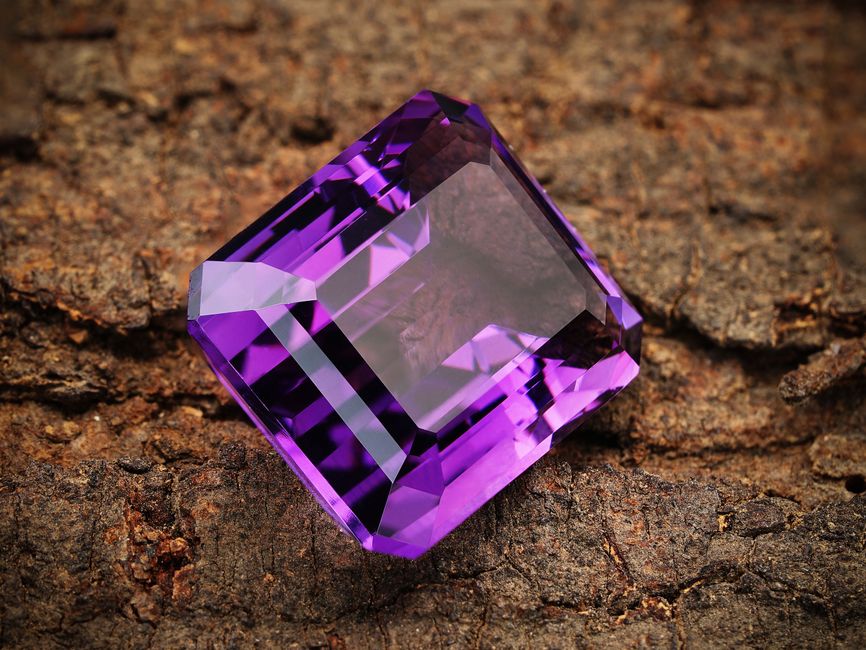
Amethyst is purple quartz (SiO₂), colored by iron impurities and natural irradiation within the crystal lattice. Mohs hardness 7. It forms in volcanic geodes and is found in Brazil, Uruguay, Zambia, and South Korea. The Greeks believed amethyst kept the mind clear — the word derives from a-methystos, meaning "not drunk" — and drank from amethyst-inlaid goblets in the hope of staying lucid through long evenings. The pharmacology was wrong; the association with clear judgment stuck.
Amethyst's color ranges from pale lavender to deep reddish-purple. The richest material, traditionally from Siberia, holds its color in artificial light better than paler stones do — an important consideration for a ring worn under office light most of the day.
The February Birthstone Ring with Amethyst in 14K Gold uses medium-to-deep saturation amethyst in a slim 14K gold band.

March — Aquamarine
Aquamarine — from the Latin for "water of the sea" — is a blue to blue-green variety of beryl (the same mineral family as emerald), colored by iron. Mohs hardness 7.5 to 8, one of the more durable stones in the birthstone collection. According to the GIA's aquamarine overview, the deepest blue stones come from Brazil's Minas Gerais state, and the storied "Santa Maria" aquamarines from the Santa Maria de Itabira mine are the benchmark for the finest color.
Roman sailors carried aquamarine carved with the image of Poseidon for protection on long voyages — a tradition Pliny the Elder documented in Naturalis Historia around 77 CE. The stone's reputation as a talisman for those who travel across water is one of the most consistent in the historical record.
The March Birthstone Ring with Aquamarine in 14K Gold sets a single clear aquamarine in 14K gold. For a March wearer building a coordinated set, the matching Aquamarine Birthstone Necklace and stud earrings are built around the same stone.


April — Diamond
Diamond is pure carbon arranged in a cubic crystal lattice — the hardest known natural material, Mohs 10. April's birthstone is the one ring in the collection whose stone effectively cannot be scratched, which is why so many engagement rings are diamond rather than any other birthstone. The collection uses small natural diamonds in a single-stone setting.
For most of human history, India was the world's only significant source of diamond; Brazilian deposits opened in the 18th century, African production began with the 1867 discovery at the Eureka Mine in Hopetown, South Africa, and Russian and Canadian sources came online in the 20th. The GIA's diamond quality factors — the 4Cs of cut, color, clarity, and carat — were standardized by the Gemological Institute of America in the 1940s and remain the global trade standard.
The April Birthstone Ring with Diamond in 14K Gold sets a single natural diamond in 14K gold — the most practical of the twelve rings to wear into work that involves your hands.

May — Emerald
Emerald is the green variety of beryl, colored by trace chromium and vanadium. Mohs hardness 7.5 to 8. According to the GIA emerald quality guide, Colombian emeralds tend warmer (yellow-green undertone) while Zambian stones lean cooler and more saturated blue-green. The famous emerald deposits at Muzo, Colombia, have been mined continuously since pre-Columbian times.
Emerald's characteristic inclusions — called jardin, French for "garden" — are accepted and even prized as proof of natural origin. They do, however, make emerald more fragile than its hardness number suggests. A May ring with an emerald should avoid ultrasonic cleaners and very harsh impact. The collection's May ring uses small accent-scale emeralds, which means the most pronounced inclusions of larger stones don't show.
The May Birthstone Ring with Emerald in 14K Gold pairs the rich green stone with the warm tone of solid 14K gold — one of the most photographed color combinations in fine jewelry for a reason.

June — Lab-Grown Alexandrite
June has three modern birthstones — pearl, moonstone, and alexandrite — and the ring uses alexandrite specifically because the other two are too soft for daily wear on the hand. Alexandrite (BeAl₂O₄, beryllium aluminum oxide) is one of the rarest gemstones in the world and famous for its color-change behavior: it appears green in daylight and red under incandescent light. Mohs hardness 8.5.
Natural alexandrite is so rare that virtually all of it on the market today is small (under one carat), and stones of any meaningful size command prices that put them out of reach for everyday jewelry. The ring uses lab-grown alexandrite, which is chemically and optically identical to the natural material — the same chrysoberyl structure, the same color-change behavior — at a fraction of the price. For a daily-wear birthstone ring, lab-grown alexandrite is the version that makes practical sense.
The June Birthstone Ring with Lab-Grown Alexandrite in 14K Gold brings the color-change effect into a wearable, daily piece. June wearers who specifically want pearl — for a non-ring piece — can find it in the matching Birthstone Edit necklace collection.

July — Ruby
Ruby is the red variety of corundum (the same mineral family as sapphire), colored by chromium. Mohs hardness 9 — second only to diamond and one of the most durable stones in any jewelry collection. The finest rubies traditionally came from the Mogok valley in Burma (now Myanmar); the modern trade includes significant stones from Mozambique, Thailand, and Madagascar.
Ruby is one of the four classical "precious" stones (diamond, ruby, sapphire, emerald) and historically the most expensive of the four per carat at top quality. The GIA's ruby quality guide identifies the "pigeon's blood" red — a vivid, slightly purplish red — as the benchmark color.
The July Birthstone Ring with Ruby in 14K Gold sets a natural ruby in 14K gold — one of the highest-durability rings in the collection and a stone that holds its saturation across every lighting condition.

August — Peridot
Peridot is one of only two gemstones (diamond is the other) that doesn't form in Earth's crust — it forms in the mantle and is carried to the surface by volcanic activity. Some peridot has been found in pallasites — stony-iron meteorites — making it one of the few gemstones with confirmed extraterrestrial origins. Chemically a magnesium iron silicate, (Mg,Fe)₂SiO₄, it exists in only one color: an olivine green that ranges from pale and lemony to deep and grass-saturated.
The ancient Egyptians called peridot "the gem of the sun" and mined it on Zabargad Island in the Red Sea for over 3,500 years, according to GIA's peridot history. Today the finest specimens come from the San Carlos Apache Reservation in Arizona, Pakistan's Kohistan district, and China. Mohs hardness 6.5 to 7 — durable enough for daily wear on the hand with reasonable care.
The August Birthstone Ring with Peridot in 14K Gold sets the olive-green stone in 14K gold — a warm-on-warm pairing that reads particularly well on most skin tones.

September — Sapphire
Sapphire is blue corundum (the same mineral as ruby, with different trace elements), Mohs hardness 9, colored by trace titanium and iron. The collection uses medium-dark, vivid blue stones — what the GIA's sapphire quality guide identifies as the benchmark hue. The legendary cornflower-blue Kashmir mines were largely exhausted by the 1920s; current high-quality production comes from Sri Lanka, Madagascar, and increasingly Montana, which has produced fine blue sapphire from the Yogo Gulch and Rock Creek deposits since the late 19th century.
Sapphire has been the stone of royalty for centuries — Princess Diana's engagement ring (now Catherine, Princess of Wales's) is a 12-carat Ceylon sapphire, which has driven sustained demand for the stone in engagement and milestone jewelry for forty years.
The September Birthstone Ring with Sapphire in 14K Gold sets a natural blue sapphire in 14K gold — the second-most durable stone in the collection after diamond, and a stone whose color holds across daylight, lamplight, and screen light without shifting.

October — Pink Tourmaline
October's traditional birthstone is opal, which is too soft (Mohs 5.5 to 6.5) and too dimensionally unstable for daily ring wear. The modern birthstone list includes pink tourmaline as October's alternate — Mohs 7 to 7.5, durable enough for daily wear and arguably the better stone of the two for a ring.
Tourmaline is one of the most chemically variable gem species in the world — the family includes elbaite, dravite, schorl, and others, with composition variations that produce stones in every color of the spectrum. The pink color in October's birthstone comes from manganese. The finest pink tourmaline historically came from California's Himalaya Mine (active from 1898) and from Maine; modern production includes significant stones from Brazil, Nigeria, and Madagascar.
The October Birthstone Ring with Pink Tourmaline in 14K Gold uses a saturated pink tourmaline in 14K gold — a softer-feeling color than October's other alternates, and one that reads as warm rather than girlish in the slim band format.

November — Citrine
Citrine is the yellow to orange-brown variety of quartz (SiO₂), colored by iron impurities. Mohs hardness 7. In ancient times it was carried by Roman soldiers for courage and called the "merchant's stone" in medieval Europe.
One worth-knowing detail: most commercial citrine on the market is heat-treated amethyst, altered to produce yellow color rather than mined as citrine in the first place. Genuine natural citrine is considerably rarer and comes primarily from Brazil, Madagascar, and Spain, according to GIA's citrine overview. The November ring uses natural citrine in a clear, warm gold-yellow that reads particularly well against the matching 14K gold setting.
The November Birthstone Ring with Citrine in 14K Gold brings the warm gold-yellow stone into a slim 14K gold band — a tonal pairing rather than a contrasting one, which suits November wearers who prefer monochrome rather than statement color on the hand.

December — Blue Zircon
Zircon (ZrSiO₄) is the oldest mineral found on Earth's surface — crystals from the Jack Hills of Western Australia have been dated to 4.4 billion years ago, older than any known rock formation on Earth, and formed when the planet was barely 100 million years old. When you wear a blue zircon, you are wearing a fragment of the Hadean Eon, the Earth's geological infancy.
One clarification worth making: natural zircon has nothing to do with cubic zirconia. CZ is a synthetic material invented in 1976 to imitate diamond. Natural zircon is among Earth's most ancient minerals and is valued in its own right. Blue zircon is produced by heat-treating brownish natural zircon to activate iron-based color centers, per the GIA's zircon documentation. Mohs hardness 7.5. Zircon's exceptional dispersion — the ability to separate white light into spectral colors, similar to diamond — gives it visual fire that rivals diamond at a fraction of the price.
The December Birthstone Ring with Blue Zircon in 14K Gold sets a vivid blue zircon in 14K gold — arguably the most visually striking stone in the collection for its price tier, and the one most likely to be mistaken for a much more expensive stone by strangers.

Building a Coordinated Birthstone Set
The ring is one of three matched pieces in the AuAlchemy birthstone collection. The same stone appears in a pendant necklace and a pair of stud earrings, all in solid 14K gold, designed to share design language so they read as one signature when worn together.
Most wearers don't put on all three at once daily. The more common rotation is:
- The necklace as the every-day piece, layered with or under other chains
- The studs as the easy default ear pair, often worn even on days when the necklace stays off
- The ring as the second-day signal — the piece that says "same wearer" when she's not wearing the necklace
For a worked example: a March-born wearer with the aquamarine ring, the aquamarine necklace, and the matching aquamarine studs has a complete personal signature across three pieces — each works alone, the set works together, and the pieces don't compete because they're sized and styled to complement.
The same logic works for any month: January garnet with the matching necklace, September sapphire with the matching necklace, and so on through all twelve stones.


Stacking Birthstone Rings
The slim solid-gold band format is designed to stack. Three reasonable approaches:
- Multiple birthstones on one finger. The classic application: a mother stacks her children's birth months, a wearer stacks her own with her partner's, a grandmother stacks every grandchild she has. The bands are thin enough that two or three together still read as a clean line rather than a clump.
- Birthstone band plus a plain gold band. The stone reads cleaner when it sits next to an unornamented metal band rather than another stone-set piece. A plain 14K gold thin band stacked above or below the birthstone ring gives the stone room to breathe.
- Birthstone band as the accent in a mixed stack. The colored stone becomes the focal point in a stack of two or three other rings — a signet, a symbol piece, a thin chain ring. The stack reads layered without competing for attention.
For more on multi-metal stacking (silver mixed with gold), see our guide to mixing silver and gold jewelry.
Care and Sizing, Briefly
Sizing. All twelve rings ship in US size 7, the most common women's ring size. Any local jeweler can resize a slim solid 14K gold band up or down for a modest fee, usually within a few days. Resizing doesn't damage the stone.
Cleaning. For most stones in the collection (Mohs 7 and above), warm water with a drop of mild dish soap and a soft toothbrush is enough. Rinse, pat dry with a soft cloth. Avoid ultrasonic cleaners for emerald (inclusion-sensitive) and alexandrite. Remove the ring before heavy gym work, gardening, and household cleaning — the gold itself doesn't tarnish, but the polish lasts longer with less mechanical contact.
Frequently Asked Questions
What is the birthstone for each month?
January — garnet; February — amethyst; March — aquamarine; April — diamond; May — emerald; June — pearl, moonstone, or alexandrite; July — ruby; August — peridot; September — sapphire; October — opal or pink tourmaline; November — citrine or topaz; December — turquoise, blue zircon, or tanzanite. Months with multiple stones reflect alternates added over various revisions of the official list.
Why does the June ring use alexandrite instead of pearl?
Pearl (Mohs 2.5 to 4.5) is too soft for a daily-wear ring — it scratches, loses luster, and chips with regular hand contact. June's modern birthstone list includes alexandrite as an alternate; at Mohs 8.5, alexandrite is durable enough to wear daily on the hand. June wearers who want pearl specifically can find it in the necklace category, where the stone isn't subjected to the same mechanical stress.
Why does the October ring use pink tourmaline instead of opal?
Same reasoning as June. Opal (Mohs 5.5 to 6.5) is borderline for ring use and prone to cracking under temperature shifts because of its water content. Pink tourmaline (Mohs 7 to 7.5) is October's modern alternate and the more practical stone for daily wear on the hand.
Is lab-grown alexandrite as good as natural?
Chemically and optically, yes. Lab-grown alexandrite has the same chrysoberyl crystal structure as natural alexandrite, the same Mohs hardness, and the same color-change behavior. The difference is geological history and rarity rather than material quality. For everyday jewelry, lab-grown is the version most gemologists recommend — natural alexandrite of any meaningful size is rare enough to be impractical for daily-wear pieces.
Can multiple birthstone rings be stacked on the same finger?
Yes — the slim band is specifically designed for this. Two or three rings stack cleanly on one finger; four or more can also work if the wearer prefers a denser look. Common patterns: a mother stacks her children's birth months, a wearer stacks her own birth month with her partner's, a grandmother stacks several grandchildren.
Will solid 14K gold turn my finger green?
No. The green-finger effect comes from copper in plated, vermeil, or low-karat alloy jewelry reacting with skin acids. Solid 14K gold has copper present but bound stably within the alloy; it doesn't migrate to the skin's surface or react the way the surface copper of plated jewelry does.
Choosing the Stone
A birthstone ring is a small object with a specific job: to read as personal on the hand of a twenty-five-year-old and on the hand of a sixty-year-old, to hold up to more mechanical contact than any other piece of jewelry, and to look correct on every day from a job interview to a Sunday afternoon. The combination of solid 14K gold band plus a properly hardness-matched natural stone is the version of that object that does the job for decades rather than years.
The Birthstone Ring Edit includes all twelve months, each priced consistently within the collection regardless of stone, ready to wear alone, stack with another month, or build into a coordinated set with the matching necklace and stud earrings for the wearer who wants the full birth-month signature across three pieces.
What it means to her after that is hers.


