
Gemstone Jewelry: Meanings, Quality, and How to Choose
A good gemstone earns its place. It catches light from across the room, it holds up to the washing of hands and the brushing of sweaters, and — quietly, when you remember to think about it — it carries a meaning that fits the moment you're in.
Most gemstone writing skips straight to mood boards. This guide skips the mood board. You'll get what each of the popular stones in jewelry actually is, what its traditional symbolism has come to mean in plain language, and the specific things to look at when you're trying to decide which one belongs around your neck or on your hand.
If you can read a stone the way a jeweler does — color, cut, clarity, and how well it stands up to daily life — you'll choose better, and you'll appreciate what you wear more.


What a Gemstone Is, Practically Speaking
A gemstone is a mineral (occasionally an organic material like pearl or amber) that's hard enough, transparent or beautiful enough, and rare enough to be cut and worn. Mineralogically, almost every famous stone you can name belongs to one of a handful of families — corundum (sapphire), beryl (emerald and aquamarine), quartz (amethyst and citrine), and so on. The GIA Gem Encyclopedia is the standard reference and a good place to lose an afternoon.
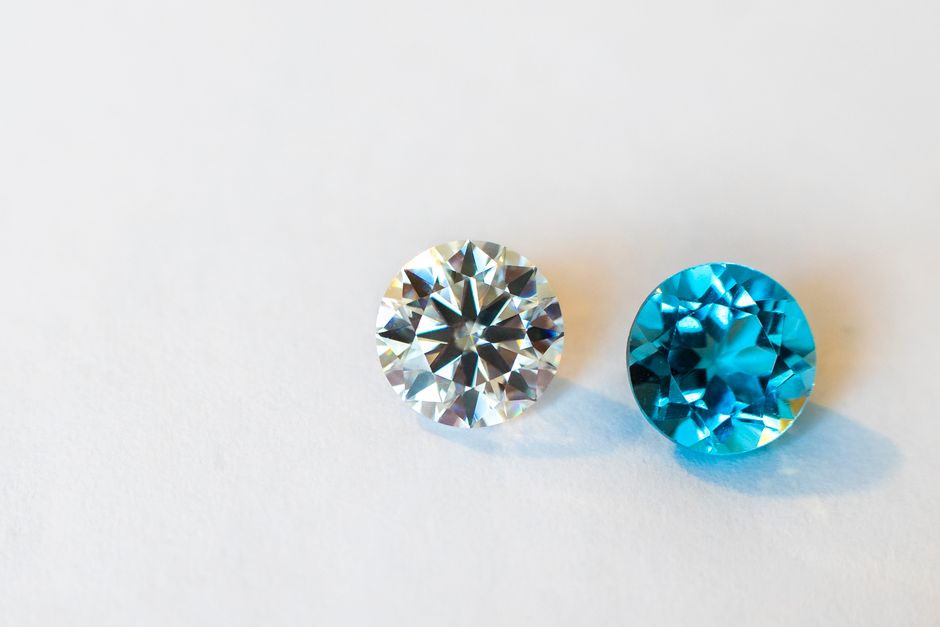
The four characteristics every gemologist evaluates — color, cut, clarity, and carat — apply to every stone, not just diamonds. Get comfortable reading those four and you can shop for any colored stone with confidence.
Most people don't know this: the "precious" versus "semi-precious" distinction is a nineteenth-century marketing leftover. Modern gemology doesn't really use it. A vivid Paraiba tourmaline can outprice a pale ruby per carat. Treat every stone on its own merits.
A Working Guide to the Stones You'll Actually Encounter
Here's how to think about the gemstones that show up most often in fine jewelry — what they are, what they've traditionally symbolized, and one practical thing to know before you buy.
Diamond
The hardest natural material at 10 on the Mohs scale, and the reason it's been the engagement stone of choice for a century. Symbolically, diamonds have come to stand for permanence and commitment in modern Western culture — a relatively recent association, but a strong one.
What to look at: cut controls how much light bounces back at you. A well-cut smaller diamond looks brighter than a poorly cut larger one. Our Diamond Accented Star Necklace in 14K Gold uses small natural diamonds set into the points of a star — proof that scale matters less than placement.
For diamond on the hand rather than at the neck, the April Birthstone Ring with Diamond in 14K Gold sets a small natural diamond in a slim 14K gold band — Mohs 10, the only ring in the collection whose stone effectively cannot be scratched.


Sapphire
Corundum colored by trace iron and titanium. Hardness 9, second only to diamond, which is why sapphires hold up beautifully in everyday rings and pendants. The cornflower-blue sapphire still sets the visual standard, but sapphires occur in every color except red (a red corundum is, by definition, a ruby). Traditionally associated with steadiness and clear thinking.
The Capricorn Zodiac Disc Necklace with Natural Blue Sapphire in 14K Gold is a tidy example — a small, well-saturated stone in a piece you can wear every day without worrying.
For sapphire in ring format, the September Birthstone Ring with Sapphire in 14K Gold sets a natural blue sapphire in a slim 14K gold band — Mohs 9 hardness makes it among the most durable ring stones in any jewelry collection.


Emerald
Green beryl, colored by chromium and vanadium. Beautiful and famously delicate — emeralds almost always have internal inclusions called jardin (French for "garden"), and most are treated with cedar oil to improve clarity. Hardness 7.5–8, but inclusions make them more prone to chipping than the number suggests. Traditionally the stone of renewal and growth.
The Aries Zodiac Disc Necklace with Natural Emerald in 14K Gold is a sensible way to wear one — a small accent stone protected inside the disc rather than a vulnerable solitaire.
The ring version of the same stone is the May Birthstone Ring with Emerald in 14K Gold — a small natural emerald in a slim 14K gold bezel, where the wraparound metal collar protects the stone's perimeter from the impact a ring typically takes on the hand.


Aquamarine
If aquamarine in its simplest form is what you want — a single natural stone bezel-set in 14K gold — the Birthstone Ring Edit carries it as the March Birthstone Ring with Aquamarine in 14K Gold. Available alongside matching pieces in the same stone across the necklace and stud earrings collections, so the full set can be built over time.

Blue beryl, colored by iron — same crystal family as emerald, very different temperament. Hardness 7.5–8 and far cleaner than its green cousin, which makes it forgiving in daily wear. Color ranges from pale sky to deep ocean blue, with deeper saturation commanding a premium. Traditionally associated with calm and clear-headed travel.
Cancer wearers can find their birthstone in the Cancer Zodiac Disc Necklace with Natural Aquamarine in 14K Gold.

Amethyst
Purple quartz, with color from iron and naturally occurring radiation in the crystal. Hardness 7, which is the practical threshold below which a stone really shouldn't be set in a ring you wear every day. Traditionally the stone of clear thinking and restraint — the Greek amethystos meant "not drunk." Make of that what you will.
A clean, deep purple amethyst is the goal; lighter, washed-out stones are common and shouldn't cost much. The Sagittarius Zodiac Disc Pendant with Natural Amethyst in 14K Gold uses a small stone where the color reads clearly.
The same purple quartz on the hand is the February Birthstone Ring with Amethyst in 14K Gold — Mohs 7, durable enough for daily wear, in a slim 14K gold band designed to stack with other birthstone rings.


Citrine
Yellow to amber quartz, hardness 7. Worth knowing up front: most commercial citrine you'll see is heat-treated amethyst. This is a standard, disclosed practice, not a defect — the result is the same mineral with a different color — but it's the kind of thing a careful seller will tell you. Traditionally a stone of warmth and abundance.
The Leo Zodiac Disc Necklace with Natural Citrine in 14K Gold shows it well — a warm amber against yellow gold reads richer than either alone.
The ring version of the same warm pairing is the November Birthstone Ring with Citrine in 14K Gold — gold-yellow stone against a 14K gold band, tonal rather than contrasting, and the warmest of the twelve birthstone rings in feel.


Opal
Not a mineral in the strict sense — opal is hydrated silica arranged in tiny spheres that diffract light into what gemologists call play-of-color. Softer than the other major stones at Mohs 5.5–6.5, which is why opal earrings and pendants outnumber opal rings in good collections. The Smithsonian's National Gem Collection houses some of the finest reference specimens.
The Diamond Star Necklace with Ethiopian Opal in 14K Gold is a piece that lives or dies on the opal's color play — and this one delivers.
October-born wearers who want a birthstone ring should know that opal itself is too soft for daily hand contact (Mohs 5.5 to 6.5, prone to scratching and to cracking with temperature shifts). October's modern alternate, pink tourmaline (Mohs 7 to 7.5), holds up to ring wear, and the October Birthstone Ring with Pink Tourmaline in 14K Gold uses it in a slim 14K gold band designed for daily wear.


How to Choose a Quality Stone
Once you've narrowed down what you want, four things tell you whether the specific stone in front of you is a good one.
- Color is the single biggest driver of price for most colored stones. You want saturation (intensity) and even distribution. Hold the stone away from the light source and look at the body — washed-out color is a dealbreaker, no matter the size.
- Cut determines whether the stone returns light to your eye. A well-cut stone looks bright across its whole face. A poorly cut one has a dark zone in the middle (a "window") or dead corners. This matters for every stone, not just diamonds.
- Clarity is about inclusions — the small features inside the stone. "Eye-clean" (nothing visible at arm's length) is the practical standard for most pieces. Emeralds are the known exception; expect a jardin.
- Hardness tells you what setting and what use are realistic. The Mohs scale is the quick reference. A stone below 7 is best in earrings and pendants rather than rings that take daily abuse.
A small, well-cut, well-saturated stone almost always looks better than a larger one with poor color or a sloppy cut. Trust your eyes more than the carat weight on the tag.
For a study in how different stones can sit together — and how a thoughtful setting protects softer stones in a piece you'll actually wear — see the Moon & Star Necklace with Natural Multi-Gemstones. It's a useful reference point even if you don't buy it.

Caring for Gemstone Jewelry So It Lasts
The biggest predictor of how a gemstone piece ages is not the stone itself — it's how you treat it.
- Take rings off for hand-washing, gardening, gym sessions, and the dishwasher. Heat plus detergent is hard on every stone, especially treated ones.
- For most jewelry, warm water and a soft toothbrush handle routine cleaning. Skip ultrasonic cleaners for emeralds, opals, turquoise, and anything that's been oiled or stabilized — the vibration can deepen inclusions or strip treatments.
- Store stones separately. A harder stone (sapphire, diamond) will scratch a softer one (opal, turquoise) if they rub against each other in a drawer. Individual soft pouches solve this.
- Have prongs checked once a year by a jeweler. A lost stone is almost always a slow-loosening prong rather than a sudden event — and it's the cheapest preventable loss in jewelry.
The full Celestial Signatures collection shows what daily-wear-friendly gemstone pieces look like in practice: small natural stones, protective bezel and disc settings, materials that hold up to a real life rather than a display case.
Frequently Asked Questions
What's the difference between a natural and a lab-grown gemstone?
Chemically, they're identical — same mineral, same crystal structure, same hardness. The difference is origin: a natural stone formed in the earth over millions of years, a lab-grown one in a controlled environment over weeks. Both are "real." Natural stones generally command a premium for their geological story and relative scarcity. The GIA grades both, and reputable sellers disclose origin on every stone.
Are heat-treated gemstones still "natural"?
Yes. Heat treatment is a long-accepted, disclosed practice that improves color in many stones — sapphires, blue topaz, and most citrine on the market. It's permanent and doesn't make the stone less real. The treatments worth asking about are diffusion (where color is added near the surface) and dyeing (mostly seen in lower-grade turquoise and opaque stones). A good seller volunteers this information.
What does Mohs hardness actually tell me?
It's a relative scale of scratch resistance from 1 (talc) to 10 (diamond). For practical jewelry purposes: 8 and above is bombproof for daily-wear rings, 7 is fine with sensible habits, below 7 is best kept off the hand and into earrings, pendants, or pieces you take off before doing anything physical. Hardness isn't the same as toughness — diamond is very hard but can chip along its cleavage planes; jade is softer but extraordinarily tough.
Why do similar-looking stones cost wildly different amounts?
Color saturation, origin, treatment status, and clarity all drive price. Two amethysts that look similar at a glance can differ tenfold once you compare them side by side in daylight. This is one of the reasons buying gemstone jewelry is worth doing in person — or from a seller whose photography you trust to be honest about color.
Should I buy by birthstone or by the stone I love?
By the stone you love. Birthstone tradition is a useful place to start — it gives you a story — but the stone you'll actually wear is the one whose color and weight you keep reaching for. A Cancer who hates pale blue should not own an aquamarine necklace, no matter what the calendar says.
How do I know I'm getting a good stone if I'm not a gemologist?
Buy from sellers who disclose treatments, name origins where they know them, and photograph stones in honest light. If a piece arrives and the color is duller than you expected from the listing, that's the seller's problem, not your taste — return it. Trust your eye, and trust a good return policy.
The Stone You Wear
A gemstone is a small object with a long timeline. The amethyst on your finger was an empty cavity in volcanic rock for millions of years before someone cut and set it. That isn't romantic exaggeration — it's geology.
Choose for what the stone actually is, and for how it actually fits your life, and you'll end up with a piece you keep wearing. Intention, made tangible. Browse the gemstone-set Celestial Signatures and the full AuAlchemy collection when you're ready to choose yours.


