
Opal: The Gemstone That Contains Entire Galaxies
No other gemstone does what opal does. Hold one up and move it — the color doesn't come from pigment, dye, or the stone's chemistry. It comes from physics. Light enters the stone, bounces off millions of microscopic silica spheres stacked in orderly grids, and exits as fire. Move the stone and the fire moves with it, rolling across the surface in colors that weren't there a second ago.
This is also why two opals are never identical, and why choosing one is genuinely different from choosing any other gemstone. You're not picking a color. You're picking a particular pattern of light — one that belongs to that stone and no other.
Understanding what creates that effect changes how you look at opals, what you look for when you're buying, and why some stones command dramatically higher prices than stones that appear superficially similar. Here's what's actually happening inside the stone, and how to use that to make a better choice.

What You're Actually Looking At: The Science of Play-of-Color
The phenomenon has a technical name — play-of-color — and according to the Gemological Institute of America, it happens when silica spheres between roughly 150 and 300 nanometers in diameter are arranged in a three-dimensional lattice inside the stone. Those spheres diffract white light, separating it into spectral components the same way a prism does — but moving, and from three dimensions simultaneously.
The size of the spheres determines which colors you see. Smaller spheres (around 150 nanometers) produce violet and blue. Larger spheres — in the 250–300 nanometer range — create red, orange, and the full visible spectrum. A stone that shows red in its play-of-color required larger, more precisely arrayed spheres to form, which is rarer. This is why red play-of-color is the quality marker jewelers watch for, and why it shifts the price significantly.
Most people don't know this: the silica that forms opal is the same material as glass and quartz, just arranged in an amorphous gel rather than a crystalline lattice. And unlike almost every other gemstone, opal contains water — typically 3 to 21 percent by weight, locked into the silica matrix during formation. That water content is structurally important, which is why opal care instructions exist and why they matter.
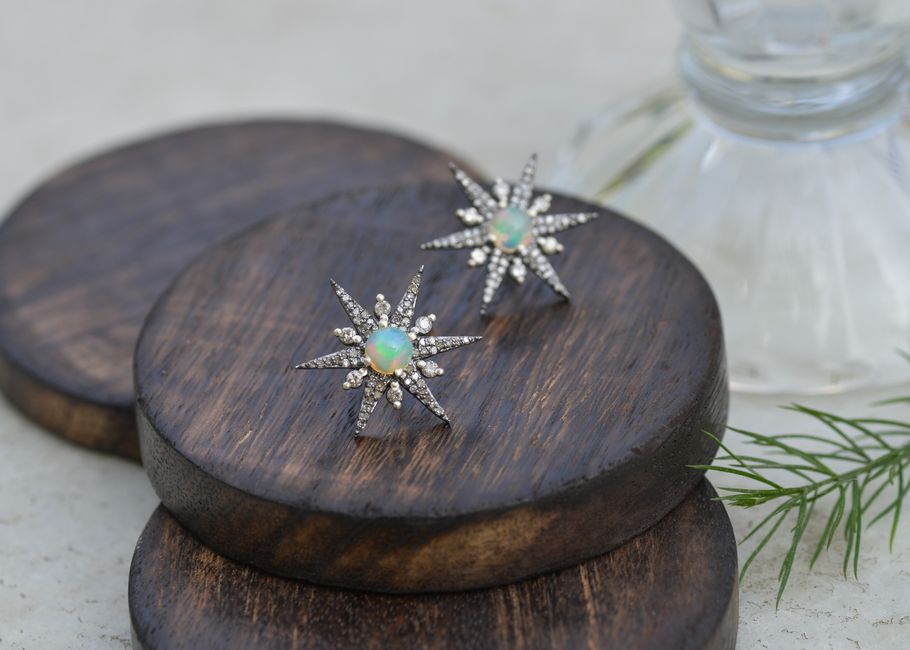
The Diamond Star Necklace with Ethiopian Opal in 14K Gold demonstrates exactly this quality. The natural Ethiopian opal at its center shows that characteristic rolling fire — spectral color moving through a translucent stone rather than sitting flat in it. Set against 14K gold with natural diamonds, it's the kind of piece where the opal is genuinely the story, with the metal and diamonds framing rather than competing.

Ethiopian vs. Australian Opals: What the Difference Means When You're Buying
Most opal available today comes from one of two places: Australia and Ethiopia. Understanding the practical differences between them helps you know exactly what you're getting.
Australian opal — particularly Lightning Ridge black opal and Coober Pedy crystal opal — has been the traditional quality benchmark for over a century. Lightning Ridge black opal has a near-opaque dark body tone, which makes play-of-color pop dramatically: colors appear to float in darkness, creating the "galaxy" effect that made these stones famous. Australian opals are generally stable and respond well to daily wear with reasonable care.
Ethiopian (Welo) opal became commercially significant around 2008 when large deposits were discovered in the Wollo Province. These stones tend toward lighter, more translucent body tones — which produces a different but equally striking effect. Rather than color floating against darkness, you get color moving through light. Ethiopian opals can show extremely vivid fire, sometimes with stronger play-of-color patterns than comparable Australian material, at generally lower price points.
The key difference in practice: Ethiopian opals are hydrophane, meaning the stone absorbs water. When wet, an Ethiopian opal will temporarily become more transparent, sometimes appearing to lose its play-of-color entirely until it dries. This is completely normal and reversible. However, repeated rapid wet-dry cycles — or extended exposure to moisture followed by drying in very low humidity — can cause the stone to craze (develop fine surface fractures). More on this in the care section.
Mexican fire opal is a third category worth knowing. These stones from Jalisco, Mexico, have warm orange to red body color with little or no play-of-color — valued for their saturated transparency rather than spectral flash. The Taurus Zodiac Disc Necklace with Natural Mexican Fire Opal in 14K Gold shows exactly this: the stone's warm amber-orange glow is the feature, a very different effect from the spectral dance of an Ethiopian specimen. For Taurus, it also carries birthstone relevance — earthy warmth rendered in something unmistakably alive.

The GIA's gem encyclopedia entry on opal notes that no single origin is categorically superior — the quality of the individual stone matters more than where it came from. A fine Ethiopian crystal opal can outperform a mediocre Australian black opal. What you're evaluating is the stone in your hand, not the geographic provenance.
The Bad Luck Myth — and Exactly Where It Started
Opal's undeserved reputation for bringing misfortune is directly traceable to a single source: Sir Walter Scott's novel Anne of Geierstein, published in 1829. The book featured an opal that changed color according to its wearer's mood and brought disaster to anyone other than its original owner. The story was compelling enough that European markets responded — opal prices reportedly dropped by half within a year of the novel's publication, and buyers actively cited the book as their reason for avoiding the stone.
There is no pre-Victorian record of opal being considered unlucky. Romans called it opalus and associated it with hope, ranking it second only to emerald among gemstones. Ancient Aboriginal Australian accounts — from the culture whose land produced the world's most significant opal deposits — describe opal as the footprint left by the Creator upon touching the earth, a creation story reported by the Smithsonian's National Museum of Natural History. The "bad luck" association is exactly 197 years old and began with a novelist.
This matters when you're giving opal as a gift or wearing it yourself. You're working with one of humanity's longest-used gemstones — mined in the Welo region since at least the 4th century, documented in European jewelry since the Roman period — not a stone with any genuine tradition of misfortune attached to it.
How to Choose an Opal: What the Experts Actually Look For
When gemologists and jewelers evaluate opal, they work through a consistent set of criteria. Knowing these lets you look at a stone the same way.
Body tone. Graded from N1 (black) to N9 (white), body tone describes the stone's background color independent of its play-of-color. Black and dark opals show the most dramatic fire because the dark background creates maximum contrast. Crystal opals are transparent. White opals are the most common and tend to show the softest color play. Price reflects body tone, with black opal commanding the highest premiums.
Play-of-color pattern. The patterns have names: harlequin (large, distinct color patches, often geometric) is the rarest and most valuable. Rolling fire describes color that moves across the stone in waves as the viewing angle changes. Pinfire is the most common — small, even points of color across the surface. No pattern is inherently better than another, but harlequin stones in gem quality are genuinely scarce, and the price reflects it.
Color range. A stone that shows red within its play-of-color is more valuable than one that shows only blue and green — not because red is more beautiful (that's subjective), but because red requires larger silica spheres to form, and those form less often. A stone that displays the full visible spectrum — red through violet in a single specimen — is exceptional. When you find one, you'll know it.
Directionality. Test this before buying: look at the stone from multiple angles. Quality play-of-color should be visible across a wide range of viewing positions, not just one optimal spot. A stone that only flashes from one precise angle is limiting to wear — you'll spend your time repositioning it. Good stones show color through natural movement.
The Ethiopian opal star necklace places the stone within a design that lets it move — the pendant hangs freely, which means the opal catches light differently throughout the day rather than sitting at a fixed angle. This is how opal is meant to be worn.
For something that pairs opal with the constellation of celestial pieces, the Moon and Star Necklace with Natural Multi-Gemstones in 14K Gold brings several stones together in a design that speaks to the same sky-and-light register opal lives in. Worn together with the opal star piece at different chain lengths, these create a layered celestial story rather than a single statement.

Caring for Opal: What the Water Content Means in Practice
Opal requires more deliberate care than most gemstones, and understanding why makes the rules feel logical rather than arbitrary.
The water locked into the silica matrix is structurally integral — it's not a contaminant or a sign of lower quality. But that water content means the stone responds to environmental changes that harder, denser minerals would ignore. Dramatic humidity swings can cause crazing — fine surface fractures that develop when the stone dries out too quickly after absorbing moisture. Ethiopian hydrophane opals are more susceptible to this than Australian material because they actively absorb and release water.
Remove before water exposure. Swimming, bathing, washing dishes — take the piece off. Chlorinated water affects the surface. Soap residue can build up in settings.
Store in cloth, not airtight containers. An airtight box accelerates moisture loss. A soft pouch or cloth wrapping allows the stone to maintain some equilibrium with ambient humidity. If you live somewhere very dry, storing a small piece of damp cloth (not touching the stone) in the same drawer maintains humidity without direct contact.
No ultrasonic cleaners. The vibration can propagate through the silica structure and cause internal fractures. Clean with a soft cloth barely dampened with clean water — nothing else.
Avoid temperature extremes. A car dashboard in direct summer sun, a radiator in winter, rapid transitions between hot and cold environments — these stress the stone. Keep it in the stable range you're comfortable in.
Opal's Mohs hardness of 5.5–6.5 is softer than most everyday jewelry gemstones — sapphire sits at 9, diamond at 10. This doesn't mean opal is fragile; jewelry designers account for hardness through setting style and metal placement, and well-set opal jewelry handles regular wear well. It does mean you store it separately from harder stones that could scratch the surface.
The Celestial Signatures collection includes pieces designed for the person who reaches for their jewelry with intention and wears it knowing what it is. Opal fits that sensibility naturally — it's a stone that rewards attention rather than one you forget about on your wrist.
For pairing: the Diamond Moon Phase Bar Necklace in 14K Gold provides a clean geometric counterpoint to an opal pendant. The bar's linearity anchors the stack, letting the opal's organic movement read clearly at a different length. Similarly, the Crescent Moon and Star Necklace in 14K Solid Gold reinforces the celestial register without repeating a similar pendant silhouette.


Frequently Asked Questions About Opal
What causes opal's play-of-color?
Silica spheres arranged in a three-dimensional lattice inside the stone diffract light, separating white light into spectral colors the way a prism does. The sphere size determines which colors appear — smaller spheres produce blue and violet, larger spheres produce red and orange. The spheres move relative to your viewing angle as the stone moves, which is why the color appears to shift.
Which is better, Ethiopian opal or Australian opal?
Neither is categorically better. Quality depends on the individual stone. Australian black opal (particularly from Lightning Ridge) has a darker body tone that makes play-of-color more dramatic; Ethiopian crystal opal tends toward lighter, translucent tones that produce a different but equally striking effect. Ethiopian opals are hydrophane and require more careful moisture management. For most jewelry uses, a high-quality Ethiopian opal at a given price point will outperform a mediocre Australian opal at the same price.
Is opal really bad luck?
No. The bad-luck reputation dates entirely to a Walter Scott novel from 1829 — there's no pre-Victorian tradition of opal misfortune. Ancient Roman, Aboriginal Australian, and pre-modern European traditions all considered opal a highly favorable stone. The association persists only because the novel was successful enough to reshape market sentiment, and cultural myths outlast their sources.
What month birthstone is opal?
Opal is the primary birthstone for October. It shares the month with tourmaline as a modern alternative. For zodiac associations, Mexican fire opal has particular resonance with Taurus given its earthy warm coloration.
Can I wear opal jewelry every day?
With appropriate precautions, yes. Remove it before swimming or bathing, clean it gently with a damp cloth, and store it in cloth rather than an airtight container. In a well-designed setting that protects the stone's edges and girdle, opal wears well as a regular piece. The care requirements are different from diamond or sapphire, not dramatically more demanding.
How should I clean opal jewelry?
A soft cloth barely dampened with clean water is all you need. No soaps, no chemical cleaners, no steam cleaners, and absolutely no ultrasonic cleaners. After wiping, dry immediately with a second soft cloth and allow the piece to air for a few minutes before storing. That's the full routine.
Why does my Ethiopian opal change appearance when it gets wet?
Ethiopian opals are hydrophane — they absorb water, which temporarily alters the stone's refractive index and can mute or completely mask the play-of-color while the stone is saturated. As the stone dries back to its normal moisture level, the play-of-color returns. This is not damage; it's how the stone works. The concern with repeated wetting isn't the temporary color change — it's the crazing risk from rapid wet-dry cycling in low-humidity environments.
Opal is the stone that doesn't hold still. Every other gemstone's color is fixed — it looked the same yesterday and will look the same tomorrow. Opal is different in this one specific way: the color exists only in the moment you're looking, produced by physics interacting with light at the exact angle and instant of your view. That's not a poetic description. That's the mechanism. It's one of the more literal examples of a stone that rewards the person paying attention — and one of the few pieces of jewelry where choosing well requires actually looking, really looking, at what's in your hand.


