
Wedding Guest Jewelry: What Works, What Doesn't
The hardest thing about choosing jewelry for someone else's wedding isn't being underdressed. It's being remembered for the wrong reason — the necklace someone noticed before the ceremony, the bracelet someone heard jingling during the vows, the earrings that competed with the bride's. The wedding guest's job is to look correct without looking memorable, and the jewelry choice does most of the work on both counts.
This guide covers the three constraints every wedding-guest piece has to satisfy at once, how the choice changes by setting and time of day, what works across the most common dress codes, and what to skip even when it feels like the obvious move. Specific pieces are noted where they fit, but the principles transfer to any catalog.


The Three Constraints, Briefly
Every wedding-guest jewelry choice has to satisfy three things at once:
- Don't outshine the bride. The unwritten rule that does most of the work. No large white stones in an obvious diamond cluster, no full bridal-style sets, no piece that asks for attention.
- Match the formality of the event. Sterling silver studs at a black-tie evening reception read as under-dressing the room. A heavy diamond pendant at a backyard barbecue reads as over-dressing the room. The piece needs to sit in the same register as the event.
- Survive six to eight hours on the body. Wedding guests stand, sit, hug, eat, dance, and stay until the cake is cut. Earrings that pinch by hour three, bracelets that slide into food, necklaces that catch on a wrap — none of these will get worn again.
The pieces that satisfy all three are usually small, in solid metal, with a single natural stone or none at all, and in a design that's been quietly correct for the last fifty years and probably will be for the next fifty.

By Wedding Setting
Black-Tie or Formal Evening
This is the most formal end of the spectrum and the one that allows the most jewelry — but the most jewelry doesn't mean the most stone. A pair of small natural diamond studs, a single fine pendant on a delicate chain, and a thin gold band on one finger reads as correctly dressed for any black-tie ceremony. The mistake here is adding a second statement piece on top of an already-strong outfit: a heavily beaded gown does not need a diamond necklace; a satin slip dress does not need a chandelier earring.
The 14K gold Diamond Accented Star Necklace sits at the most universal mid-formal weight for evening — a small, repeated diamond accent across a clean shape, in a length (16–18 inches adjustable) that pairs cleanly with most evening necklines.

Cocktail or Mid-Formal
The widest category and the easiest to dress. Cocktail weddings usually mean a midi-length dress, a structured jumpsuit, or a knee-length tea-length cocktail dress in a non-white color. The jewelry register: small to medium scale, single piece of visible interest, optional second small piece (a ring, a pair of studs) as a coordinating note rather than a competing one.
A small symbol pendant in 14K gold — the Diamond Crescent Moon Necklace in 14K Gold, for instance, or a zodiac disc from the Celestial Signatures collection — fits cleanly. A bezel-set birthstone pendant from the Birthstone Edit works for guests who want a piece tied to themselves rather than to the occasion.

Garden, Afternoon Outdoor, or Brunch
Outdoor daytime weddings reward smaller scale and lighter color. The combination of natural light, fabric movement in wind, and the absence of evening glamour means oversized stones and dramatic statement pieces read as out-of-context rather than as elegant. A pair of small studs (gold or birthstone), a single thin chain at the collarbone, and a thin stackable ring is enough. Adding more starts to look styled rather than natural.
Sterling silver works particularly well at garden weddings because it reads softer against natural light than yellow gold does, and outdoor settings tend to favor a quieter metal. The Lotus Sterling Silver Necklace is the kind of small, considered pendant that suits a garden-wedding aesthetic without registering as bold.

Beach or Destination
Beach weddings argue for the smallest scale, the lightest weight, and the most resilient materials. Sand, salt water, and humidity are hard on jewelry; sweat is hard on delicate clasps; sunscreen residue dulls polished metal. Recommendations:
- Small solid gold studs or small natural-stone studs (won't tarnish, won't snag on a beach wrap)
- A single thin chain at the collarbone
- No bracelets that swing or catch
- One ring at most — and ideally not the engagement ring if the wearer has one (sand inside the prong setting is harder to clean than people expect)
Pearls, despite their classical wedding-guest reputation, are a poor choice for beach weddings — sweat and sunscreen damage the surface, and pearls are too soft (Mohs 2.5 to 4.5) to handle the day cleanly.
Courthouse or Micro-Wedding
Small and informal. The guest's job is to be present, not to dress the room. A single fine piece — one pendant or one pair of studs — is enough. Anything more reads as overcompensating for the lack of formal occasion. This is the category where a sentimental piece (a birthstone pendant, a piece passed down) tends to land better than something purchased for the day.
By Time of Day
The conventional rule is that smaller stones and warmer metals suit daytime, while larger stones and cooler metals (white gold, platinum) suit evening. The conventional rule still mostly holds, with one update: mixed-metal stacks have made the warm-versus-cool distinction less strict than it used to be.
The practical version of the rule:
- Before sundown: smaller stones, warmer metals, fewer pieces. Natural light flattens out the visual weight of a heavy piece, which can make it read as dull rather than as elegant.
- After sundown: a single more substantial piece becomes appropriate. Stones that have visual dimension under artificial light — sapphire, ruby, diamond, blue zircon — read more clearly in the evening than at noon.
- Outdoor receptions that bridge day and evening: choose for the ceremony hour. A piece that works at 5 p.m. usually still works at 9 p.m.; the reverse is less reliably true.
By Neckline
The single most useful styling principle for any wedding-guest piece is matching the necklace to the neckline. The wrong combination reads as accidental even when the piece itself is excellent.
- V-neck: a pendant that sits at the V's base, on a chain length that doesn't compete with the neckline's depth. 18–20 inches typically works.
- Halter or high collar: skip the necklace entirely. Statement earrings handle the visual focus on their own.
- Strapless or bardot: a single small pendant at 14–16 inches, sitting at the collarbone rather than dropping toward the neckline.
- Boat neck or jewel neck: a pendant at 18 inches or layered short-and-long pendants. The high horizontal neckline frames the layered look cleanly.
- Wrap or surplice: 16–18 inches with a small pendant. The asymmetric wrap fights heavier necklaces.
For more detail on the necklace-to-neckline relationship, see our layering necklaces guide.
What Works Across Almost Every Wedding
- A pair of small diamond stud earrings in 14K gold. The single most universally correct earring for any wedding from courthouse to black-tie. Sized small (around 3–4mm at the stone) is the safer end; nothing bridal about them, nothing that competes with anyone else's piece. The Diamond Birthstone Stud Earrings in 14K Gold sit at this scale.
- A single fine pendant on a 16–18 inch chain. Star, moon, zodiac disc, birthstone solitaire — the specific shape matters less than the principle of one piece doing the work.
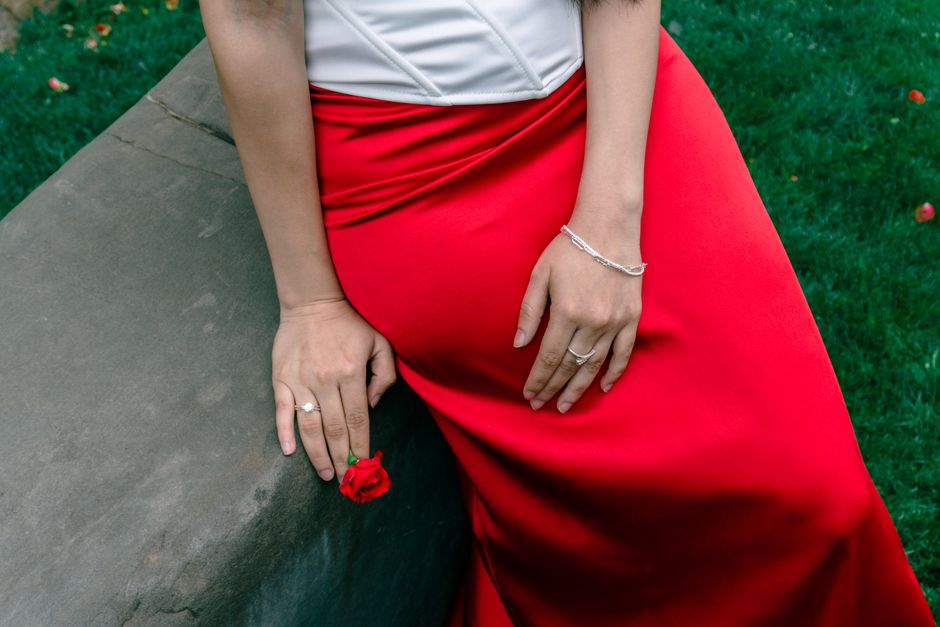
- One thin stackable ring on a hand that doesn't carry an engagement ring, or a thin band stacked next to the engagement ring rather than on a different finger. The Birthstone Ring Edit in the wearer's own birth month works particularly well — slim, personal, and not engagement-coded.
- Mixed-metal layering, kept restrained. A 14K gold pendant layered with a sterling silver pendant works at most weddings as long as the two pieces share a quiet visual language. See our guide to mixing silver and gold jewelry for the rules.
- A thin chain bracelet on the non-watch wrist, for guests who want some movement at the wrist without the noise of a charm bracelet or the weight of a tennis bracelet.
What to Skip
A short list of common wedding-guest mistakes that consistently read as wrong:

- Any large white-stone cluster that could read as bridal. A diamond halo necklace, an oversized cubic zirconia pendant, an obvious bridal-style sapphire-with-diamond-halo ring. The point isn't whether anyone seriously thinks the guest is the bride; the point is that the silhouette competes with bridal jewelry rather than complementing it.
- Full matching sets bought for the occasion. A matching necklace, earring, and bracelet set in identical metals and identical stones reads as costume rather than as fine jewelry. Wedding-guest jewelry should look chosen from a collection built over years, not assembled the week before.
- Anything that jingles, swings, or rattles. Bangle stacks that clink during the ceremony, chandelier earrings that swing during conversation, charm bracelets that catch on dress fabric. The wedding is six to eight hours of sustained close contact; pieces that announce themselves get noticed for the wrong reason.
- Statement pieces that depend on context the room won't provide. A dramatic vintage piece worked into a contemporary outfit can be wonderful in the right setting, but a wedding usually isn't that setting.
- Anything plated. A six-to-eight hour day with hugging, dancing, and the inside of a clutch is harder on plated jewelry than people expect. Solid metal is the only category that survives the day looking the same as it started. For background on the materials, see our understanding 14K gold guide.
- Heavily personalized or initialed pieces visible to the photographer. A guest's initial pendant in a wedding photo dates the photo to the guest more than to the wedding. Personal pieces are wonderful; just not the ones the photographer will catch at the altar.
A Wedding-Guest Capsule
For guests who attend several weddings a year, building a small capsule that handles most events is more practical than choosing per-event. A workable five-piece capsule:
- A pair of small 14K gold diamond studs (universal, every wedding)
- A 14K gold pendant necklace at 16–18 inches — a diamond-accented star, crescent moon, or a small zodiac disc
- A sterling silver pendant on a longer chain (20 inches) for layering or for daytime/outdoor weddings on its own
- One thin stackable ring (birthstone, plain, or symbol)
- A thin chain bracelet — gold or silver — for the non-watch wrist
This set handles most weddings from courthouse to black-tie with adjustments to which pieces are worn that day, not which pieces are owned. Worn alone, each piece reads as a single quiet choice. Worn layered, the capsule produces three or four different deliberately-styled looks without any wedding-day shopping.
Frequently Asked Questions
What jewelry should you not wear to a wedding?
Three categories to avoid: anything that could be confused with bridal (large white-stone clusters, full matched sets, prominent solitaires in white stones), anything that competes with the bride for attention (statement-scale stones, chandelier earrings with a strapless gown, anything overtly dramatic), and anything that won't survive six to eight hours of wear in close company (plated metals, jingling bracelets, pieces with weak clasps).
Can I wear pearls to a wedding?
Yes — pearls are the most classical wedding-guest stone and read as appropriate for nearly every setting except beach (sweat and sunscreen damage pearl's surface). A single strand or a pair of pearl studs is conservative and unobjectionable. Pearl can also read as slightly traditional, which suits older guests and church ceremonies better than it suits very modern minimal couples; read the room.
Is it okay to wear a colored gemstone to a wedding?
Yes, and often more interesting than wearing white or clear stones. A small natural sapphire, garnet, or aquamarine pendant in 14K gold reads as personal rather than as bridal, and colored stones generally avoid the do-not-compete-with-the-bride concern entirely. Match the stone's saturation to the setting — a deep ruby works at evening receptions; a paler aquamarine reads better in daytime light.
What kind of jewelry is best for an outdoor wedding?
Smaller scale, lighter weight, less reflective. Natural light flattens visual depth, so pieces that work indoors under chandelier light can look heavier outdoors. Sterling silver tends to suit garden settings better than yellow gold; small studs and a single thin chain handle most outdoor weddings without needing more.
Should I wear my engagement ring to someone else's wedding?
Yes, on the same hand and in its usual configuration. Wearing an engagement ring to someone else's wedding has always been correct etiquette; the only question is whether to add additional rings on the other hand. If your engagement ring is unusually large or has a halo that reads as bridal, balance it with restrained pieces elsewhere on the body rather than removing it.
How much jewelry is too much at a wedding?
The general rule: one statement piece, supported by smaller coordinating pieces. A statement necklace plus small studs and a thin ring is one statement. A statement necklace plus statement earrings plus a stacked bracelet plus three rings is four statements and is too much. The piece a guest reaches for first when getting dressed is usually the right statement; everything else should support it rather than compete with it.
What's appropriate for a same-sex or non-traditional wedding?
The same principles. The bride/groom dynamic isn't the actual constraint — the actual constraint is don't compete with the couple, however they're presenting. Read the formality, read the setting, and choose accordingly. The guest-jewelry rules are about respect for the day and the people in it, not about a specific gender configuration.
What if I don't know the dress code?
Ask the couple, or the wedding party. The invitation usually tells you ("cocktail attire," "black-tie optional," "festive"), but if it doesn't, ask someone who would know. Defaulting to over-dressed at a casual wedding is worse than defaulting to slightly under-dressed at a formal one; the jewelry can be scaled down on the way out the door more easily than scaled up.
Choosing the Pieces
The right wedding-guest jewelry doesn't get noticed. It supports the outfit, fits the formality, and stays on the body cleanly for the full day. Two months from now the guest will remember the ceremony, the food, the toast, and the friend she sat next to — not what she wore on her ears. That is the goal.
The pieces in this guide are drawn from the broader principle that good fine jewelry is built quietly and worn confidently. The full AuAlchemy catalog is built around exactly that — solid 14K gold and sterling silver, simple symbol and birthstone designs, natural stones, no plating, no costume — which is the same brief a wedding-guest piece has to meet.
What the pieces mean to the wearer after that is hers.


