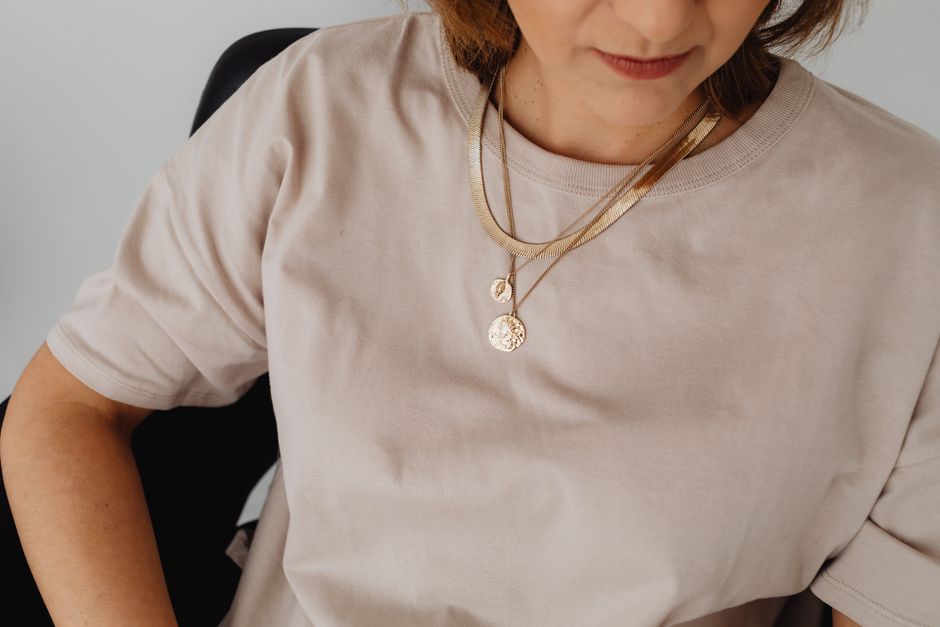
How to Layer Necklaces: Chain Lengths, Proportions, and What Works
Share
Three necklaces you love individually. Worn together, they settle at the same spot on your chest, tangle before you've left the mirror, and somehow make each piece look cheaper than it does on its own.
This is not a taste problem. It is a proportion problem — and it has a clear, learnable solution. The difference between a layered stack that reads as intentional and one that looks like you grabbed everything off your nightstand comes down to three variables: chain length, visual weight, and the relationship between pendants. Understand those three things, and you will never second-guess a stack again.
What follows is the practical framework: the actual measurements, how to balance pendants of different sizes, how to mix metals without it looking accidental, and how to build symbolic combinations that feel coherent rather than cluttered.
Photo: COPPERTIST WU / Pexels License
Start Here: The Six Chain Lengths and What They Do
Chain length is the single most important variable in necklace layering. Get this right and most other problems solve themselves. Here are the six standard lengths, where each sits on the body, and what role each plays in a layered stack:
14 inches — choker: Sits at the base of the throat. Creates a strong architectural anchor at the top of a stack. Works best with low necklines or as the shortest piece in a maximalist build.
16 inches — collar: Just below the collarbone. The most universally flattering length — works with almost every neckline and body proportion. If you own only one necklace length, make it 16".
18 inches — princess: Falls at the upper chest. The natural middle layer. Long enough to read as clearly distinct from 16", short enough that a pendant at this length stays prominently visible.
20 inches — matinee: Mid-chest. Ideal for a pendant you want to be seen — a symbol, a stone, something that carries meaning. A Hamsa at 20" sits exactly where the eye falls naturally when looking at someone. This is the right length for a statement piece.
22–24 inches — opera: Falls to the bust. Best used as the longest layer, or worn alone as a clean, graphic line through an outfit.
28–36 inches — rope: Can be doubled or worn full-length. For maximalist builds or when you want a strong vertical accent.
The Two-Inch Rule
Every layer needs at least two inches of separation from the one above it. Less than that, and chains lie on top of each other, tangle constantly, and the individual lengths become indistinguishable — the whole point of layering collapses. The classic three-layer build — 16", 18", 20" — steps down in exactly two-inch increments and creates a clean cascade the eye reads immediately as composed.
You can break the rule deliberately. Pairing 16" and 22" skips the middle entirely and creates a dramatic gap that works when you want one piece to stand clearly apart from another. The rule prevents accidental proximity; it does not limit intentional range.
Match Length to Neckline
V-neck: Follow the V. Your longest pendant should land at or just below the apex of the V, echoing the neckline downward. 18"–20" range for most V-necks.
Scoop neck: Shorter layers (16"–18") fill the exposed neckline without disappearing into it. A bar necklace at 16"–18" sits cleanly here.
Crew neck: Go longer — 20"+ — so pendants fall below the neckline and don't compete with the garment's collar.
Turtleneck: 22"+ only, extending clearly below the turtleneck. One piece, one length. The Star Necklace in 14K Gold on a long chain against a dark turtleneck creates a striking, graphic point of focus.
Off-shoulder or strapless: The most forgiving neckline for layering. Almost anything works. Start here if you're experimenting with layered builds for the first time.
Photo: Lum3n / Pexels License
Visual Weight: The Variable Nobody Talks About
Length creates structure. Visual weight creates hierarchy. Every necklace in a layered stack has a weight — how much visual space it occupies, how much attention it asks for — and the stack works when those weights are arranged in a coherent order, not competing at the same level.
Base layer (shortest): Minimal weight. A plain chain, a small geometric charm, or a bar necklace. Its job is to anchor the stack and create separation — not to compete for attention. The Moon Phases Diamond Bar Necklace works perfectly here: the horizontal line creates quiet structure, and the moon phase engraving rewards close attention without demanding it from across the room.
Middle layer: Moderate weight. This is your most personally meaningful piece — a symbol, a birthstone, something with a story. It sits at the center of the composition and functions as the focal point of the stack.
Longest layer: Either a strong statement (if your middle is understated) or deliberately minimal (if your middle is bold). These two should never compete. When both layers are bold, one wins and the other just looks like noise.
Why Bar Necklaces Are Underrated Layering Tools
A bar necklace introduces a horizontal element into what is otherwise a series of vertical lines — hanging chains, dangling pendants, all pulling downward. The bar interrupts that rhythm, creates a visual rest point, and cleanly separates pieces above from pieces below without competing with either. It also moves differently from hanging pendants, which reduces tangling. In a three-layer stack, a bar at the middle length is often the best structural choice you can make.
Symbolic Layering: Compositions That Mean Something
The most compelling layered stacks aren't assembled by accident — they're composed around a logic. A few combinations that work both visually and symbolically:
Protection + Celestial: An evil eye or hamsa at 16"–18", a star or moon pendant at 20"–22". Protection close to the heart, the celestial anchoring below. The symbolic logic compounds — one watching, one illuminating above.
Spiritual + Personal: A universal symbol at the collar — a lotus, an om, an ankh — with a personal zodiac or birthstone piece longer. The universal and the individual in the same composition, each giving the other context.
Bold + Quiet: One statement pendant with real visual presence, paired with a plain chain at a different length. Let one piece speak; let the other create space around it. This is a harder combination to pull off than it sounds — resist the urge to fill the plain chain with a second pendant.
Birthstone + Zodiac: A birthstone solitaire from the Birthstone Edit at 16″ layered over a zodiac disc from Celestial Signatures at 18″. The same person rendered two ways — the calendar-month gem above, the sun-sign constellation below — reads as deliberate rather than redundant. Particularly effective for signs whose zodiac stone happens to differ from their birth-month stone (Aries, Gemini, Cancer, Leo, Scorpio, Sagittarius, Capricorn), where the stack shows two related but distinct stones at two lengths.
Photo: Anna Tarazevich / Pexels License
Mixing Metals: The Rule That Doesn't Exist
The "never mix gold and silver" convention is a mid-20th-century invention with no historical basis. Mixed-metal adornment has been standard practice across most cultures and periods — ancient Roman women combined electrum (a natural gold-silver alloy) with pure gold without a second thought, and the Victoria and Albert Museum's jewelry history documents mixed-metal combinations as the norm rather than the exception across most of recorded history. The matching-metals rule is an anomaly, not a tradition.
What actually matters is not whether your metals match, but whether the mixing looks deliberate:
Repeat each metal at least twice. One silver piece in an all-gold stack reads as an oversight. Two silver pieces among three gold ones reads as an intentional choice. The repetition is what signals that the contrast was chosen.
Use a unifying element. A shared chain style (cable chain in both metals), a shared stone color, or a repeated motif ties mixed metals together across their surface difference and makes the combination feel composed rather than random.
Consider temperature. Yellow gold and rose gold are warm; white gold and sterling silver are cool. Mixing within a temperature family is naturally harmonious. Mixing warm and cool works too, but benefits from a bridge — often a stone that carries both tones, or a neutral element like a plain bar chain.
One plain chain at 16"–18". One meaningful pendant at 20"–22". That is the whole formula. This combination works for almost every neckline, occasion, and personal aesthetic. If you are new to layering, build this first — and stop. Wear it for a week. Then consider adding a third piece.
The beginner mistake is adding three or four pieces before understanding how two interact. Two is a relationship. Four is a crowd.
Three Layers: The Sweet Spot
Three layers is where most people land and rarely need to go beyond. Use the 16"–18"–20" spacing as your starting framework and assign each layer a role: base (anchor), middle (story), long (accent or statement). The middle layer carries your most personally significant piece.
One combination that works well across all three variables — weight, length, and symbolic logic: the Moon Phases Bar Necklace at 16" as the base, a Lotus Necklace at 18" as the story, a Star Necklace in 14K Gold at 22" as the accent. Three distinct weights, three distinct lengths, three symbols that speak to each other.
Four or More Layers: The Rules Get Stricter
Four or more layers requires deliberate management at every level:
Mix chain styles — box, cable, herringbone — so each layer is visually distinct and moves differently
Limit pendants to two or three; let some chains be pendant-free so the eye has places to rest
Use one unifying element across all layers: a shared metal tone, a repeated stone color, or a consistent motif that threads through the whole composition
Make the longest layer a lariat or Y-necklace — the descending vertical line anchors the whole stack and gives it a natural terminus
Two chains within half an inch of each other don't read as layers. They read as tangles. Apply the two-inch rule without exception. When in doubt, go further apart, not closer together.
2. Two bold pendants at adjacent lengths
Bold pendants compete. If you have two statement pieces you love equally, place them at least 4" apart — or wear one per occasion. Each piece benefits from being the focal point of its own composition rather than fighting for attention in a shared one.
3. Storing pieces together
The primary cause of tangled necklaces is not wearing them — it's storing them in a pile. A jewelry board with individual hooks eliminates tangling entirely. For travel: one necklace per small zip-lock bag, or thread each chain through a plastic straw before clasping to keep it straight and taut.
4. Ignoring different tarnish rates when storing
Sterling silver tarnishes faster than gold, and the reaction accelerates when silver is stored in contact with other metals. Store silver and gold pieces separately. Wiping all pieces with a soft dry cloth after wearing — removing skin oils before storage — is the single most effective maintenance habit for any metal jewelry, per GIA's metal care standards. Two minutes after you take off a piece matters more than deep-cleaning it once a year.
5. Mixing chain styles without a plan
Mixed chain styles — herringbone, figaro, box, cable — can be beautiful or chaotic depending on intention. One rule that prevents most problems: sequence from lightest to heaviest as you go from shortest to longest. Never place a heavy chain at an adjacent length above a delicate one — the weight and movement of the heavier chain will flatten and tangle the finer piece.
Frequently Asked Questions
How many necklaces should I layer at once?
Two to three is the most wearable range for daily use. Three to five works well for occasions where jewelry is intentionally featured. More than five requires real skill to avoid looking cluttered. Start with two, master that combination, then add a third only when the first two feel natural and composed together.
Can I mix gold and silver necklaces?
Yes. The prohibition against it is a 20th-century convention with no historical basis. Repeat each metal at least twice so the mixing reads as deliberate, and use a unifying element — shared chain style or stone color — to tie them together visually.
What necklace length should I start with?
16" or 18" as your foundation. These work with almost every neckline and body proportion. If you're building a collection from scratch, 18" is the single most versatile length — everything else layers naturally below it.
How do I stop necklaces from tangling?
Store pieces separately (individual hooks or zip-lock bags), use different chain styles for different layers so they move independently, and maintain at least 2" of length difference between layers. For travel, thread each chain through a plastic straw before clasping.
Can I layer chunky chains with delicate ones?
Yes, with one rule: delicate above, heavier below. A heavy chain at the same or adjacent length as a delicate one will crush and tangle it. Sequence from lightest (shortest) to heaviest (longest) without exception.
What necklace length works best with a V-neckline?
18"–20" for most V-necks. The longest pendant in your stack should land at or just below the apex of the V, echoing the neckline's angle rather than cutting across it.
Can I layer necklaces with different symbols — from different traditions?
Yes, and the most interesting layered stacks do exactly this. A lotus and an evil eye, a crescent moon and a hamsa, a star and an ankh — pieces from different traditions read as a personal composition when they share a visual logic (length hierarchy, weight distribution) even if their symbolic origins differ. The combination becomes its own statement.
A Stack Is Never Really Finished
The most useful thing to understand about layered necklaces is that a stack is a living composition — not a fixed outfit. You pull one piece out for daily wear, add two for an occasion, swap a gold chain for silver depending on what you're wearing. The pieces remain in conversation with each other even when worn separately, which is the real argument for building a collection of meaningful pieces rather than accumulating individual ones.
Choose pieces that mean something to you, arrange them with care for length and weight, and you'll end up with a stack that feels unmistakably like you — and that you'll reach for every time without thinking twice about whether it works.