

Stacking Symbol Rings: Hamsa, Evil Eye, Yin Yang, Claddagh
The four symbols in this post don't naturally belong together. The Hamsa is a Middle Eastern and North African protective form. The Evil Eye traces through Greek and Mediterranean lineages. The Yin Yang is Chinese. The Claddagh is Irish. They share neither geography nor heritage nor visual vocabulary. A stack that puts them all on one hand might sound, in theory, like a costume mistake.
In practice it's one of the most popular multi-symbol stacks worn today, and it works for a single reason: each symbol speaks to a different quality the wearer wants to carry — protection, balance, loyalty, watchfulness — and when the rings themselves are sized and finished to share the same visual language, the meanings stack as cleanly as the metal. This guide covers how to make that work.

What Each Symbol Is, Briefly
Each section keeps the history short — enough context for the stack rather than a full account. Linked guides cover the full background of each symbol.
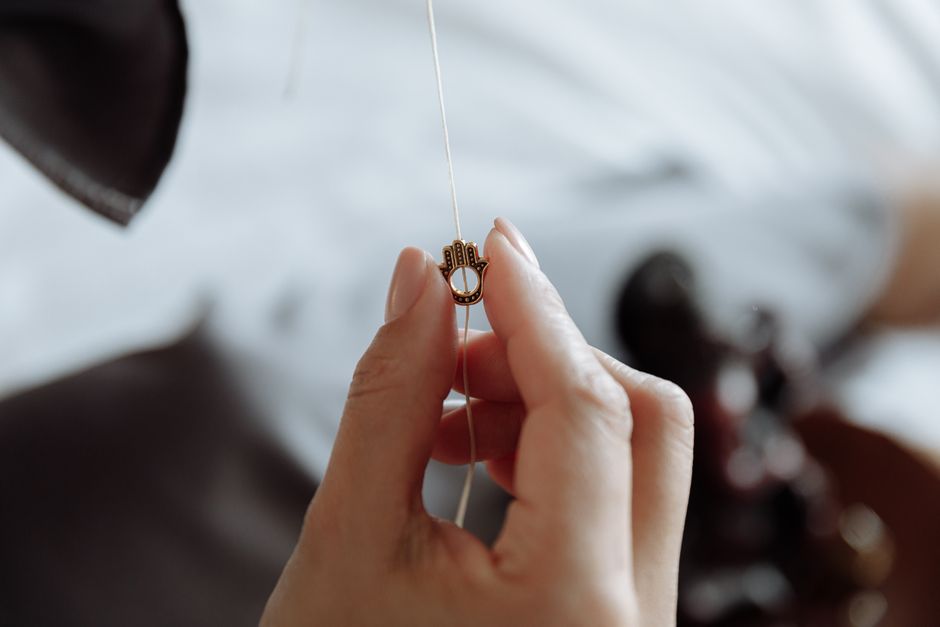
Hamsa
A stylized hand, palm-out, often with an eye centered in the palm. Originates in Middle Eastern and North African cultures and appears across Jewish, Christian, and Muslim traditions over the past two millennia. Worn today as a secular protective symbol — a reminder against the kind of attention the wearer would rather not invite. For more, see our guide to the Hamsa Hand.
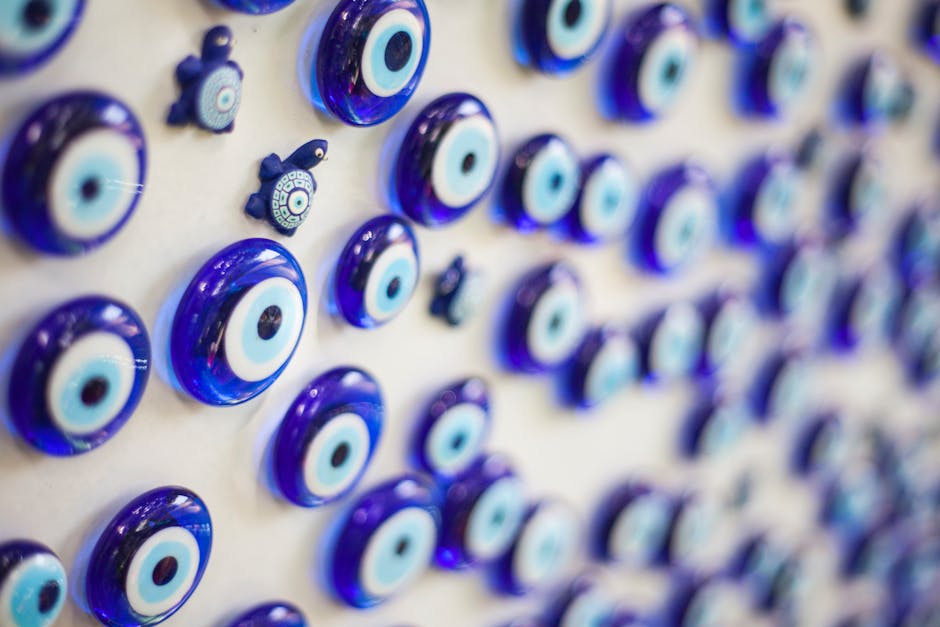
Evil Eye
The blue or concentric-circle eye motif, present in Greek, Turkish, and broader Mediterranean traditions for at least 5,000 years. Function in modern wear: not the eye itself, but the eye that watches back — a small object meant to absorb and deflect unwanted attention. See our Evil Eye guide for the full history.
Yin Yang
The Chinese symbol of complementary opposites — light and dark, soft and firm, restful and active — held in dynamic balance rather than opposition. Worn as a reminder that the two halves of any tension typically need each other. Our Yin Yang explainer covers the philosophical context.
Claddagh
An Irish symbol — two hands holding a crowned heart — representing friendship (hands), love (heart), and loyalty (crown). Originates in 17th-century Galway, originally as a marriage-and-friendship ring with specific traditional rules about which way the heart faces. Modern wearers often wear it for the meaning rather than the marital signal. Full background in our Claddagh ring guide.
Why These Four Stack Well Together
The argument for putting four symbols from four different traditions on one hand isn't that the symbols are related. They're not. The argument is that the qualities they each represent — protection, watchfulness, balance, loyalty — sit comfortably next to each other in one person's hand without any of them needing to be the dominant note.
Three structural reasons the stack tends to work visually:
- Shared metal family. All four symbols are most commonly worn in sterling silver — the historical and aesthetic default for protective and folk jewelry across each tradition. A stack of four sterling rings reads as one design family, regardless of what's on each band.
- Similar band proportions. The slim 1–3mm band format is the universal format for all four symbols' stackable versions. Bands in that range nest cleanly, occupy roughly the same finger real estate, and don't fight for space.
- Different visual rhythms. The Hamsa is a hand. The Evil Eye is a circle. The Yin Yang is a curved division. The Claddagh is a heart-and-crown composite. Each symbol has a distinct silhouette, so even when stacked tightly the eye can pick out which is which without effort. Rings that all look the same blur together; these don't.
For broader principles of ring stacking — proportion, anchor pieces, mixing metals — see our complete guide to stacking rings.
The Sterling Silver Symbol Rings to Build With
Specific pieces from the catalog that fit the stackable format for each symbol:
Hamsa
The Sterling Silver Hamsa Stackable Ring is the dedicated stackable version — a slim band with the hamsa rendered in low relief, designed specifically to sit next to other thin bands without competing for visual space. The Sterling Silver Diamond Hamsa Ring is the more substantial alternative, with a small natural diamond accent at the center — better as the anchor of a stack than as a middle ring.


Evil Eye
The catalog has three evil-eye rings, each suited to a different role in a stack. The Sterling Silver Blue Enamel Evil Eye Ring is the thinnest and most layerable — a stamped silver band with a small blue enamel eye, sits cleanly as a middle or whisper piece. The Sterling Silver Aquamarine & White Sapphire Evil Eye Ring uses natural gemstones in place of enamel for the eye, which raises both the price and the visual weight. The Sterling Silver London Blue Topaz Evil Eye Dome Ring is the statement option — taller, more dimensional, and the right choice as a stack anchor rather than a layered middle piece.


Yin Yang
The Yin Yang Sterling Silver Ring sets the curved division of the symbol into a clean band — the design's two halves rendered in a single piece of contoured silver rather than as inlay. Slim enough to layer, distinctive enough to read clearly from across a table.

Claddagh
Two versions in the catalog. The Claddagh Ring with Garnet — Sterling Silver sets a small natural garnet in the center of the crowned heart — the stone color adds a January-birthstone layer to the symbolism for wearers whose birth month happens to align. The Claddagh Ring in Sterling Silver — Youth Size is smaller-scaled and an honest fit for petite fingers or for stacking on a pinky alongside a primary stack on the ring finger.


Three Sample Stacks
The Full Four-Symbol Stack
Worn on a single finger — typically the index or the middle, which give the symbols the most visibility. The construction:
- Anchor: the London Blue Topaz Evil Eye Dome Ring at the base. The stone gives the stack a visual focal point and a color anchor in deep blue.
- Frame: the Diamond Hamsa Ring stacked above. The diamond accent ties back to the topaz visually — small white sparkle reads as a counterpoint to the saturated blue.
- Middle: the Yin Yang Ring as the third layer. The curved division contrasts with the eye-and-hand visual weight of the two below it, giving the stack rhythm.
- Whisper: the Claddagh with Garnet as the top ring. The garnet picks up the warm balance against the blue-and-white of the stones below it; the heart shape reads as the smallest visual element at the top.
Why it works: each ring carries a different silhouette, each has a different stone (topaz, diamond, no stone, garnet) so the colors form a story rather than a clash, and the band widths progress from heaviest at the bottom to lightest at the top.
The Two-Symbol Pairing
Most wearers don't want four rings on one finger. A two-ring stack is more common and arguably more wearable. The two combinations that work best from this set of four:
Hamsa + Evil Eye. Both protective symbols, both rooted in Middle Eastern and Mediterranean tradition. The pairing reads as one coherent protective gesture rather than as two unrelated rings. Use the Sterling Silver Hamsa Stackable Ring with the Sterling Silver Blue Enamel Evil Eye Ring. Both slim, both stamped silver, both protective.
Yin Yang + Claddagh. One is an Asian philosophical symbol about complementary balance; the other an Irish relational symbol about friendship-love-loyalty. They share neither geography nor heritage, but they share a structural idea — two parts held together in a meaningful relationship. The Yin Yang Ring paired with the Garnet Claddagh reads as a small philosophical statement on the hand.
The Three-Symbol Stack With a Plain Band
For wearers who want symbol rings but find a four-stack visually crowded, dropping one symbol and adding a plain band gives the stack room to breathe. A workable construction:
- The Hamsa Stackable as the lower band
- A thin plain sterling silver band as the middle (no symbol — visual rest)
- The Blue Enamel Evil Eye on top
The plain middle band lets each symbol read clearly without the symbols competing for attention. This is the easiest stack to wear at the office — the silver-on-silver-on-silver palette is quiet enough for any setting, the symbols are present but not insistent.
Adjacent Symbols Worth Considering
The four symbols in the title aren't the only options for a sterling silver symbol-ring stack. Two adjacent pieces from the catalog work as substitutes or additions:
- The Sterling Silver Trinity Stackable Ring shares the Celtic family with the Claddagh and pairs well with it as a two-Celtic mini-stack within a larger composition. The trinity knot's three interlocking loops read as a continuous-line pattern rather than a discrete symbol.
- The Sterling Silver Stackable Eye of Providence Ring is the second eye-form in the catalog (alongside the evil eye), and uses a triangle-and-eye composition. Substituting it for one of the evil-eye rings in a stack changes the cultural lineage but keeps the eye-as-protective-watcher idea intact.
Mixing Metals: When to Add 14K Gold
The four-symbol stack works best in sterling silver because each symbol's traditional and contemporary expression is most commonly silver. That said, adding a single 14K gold ring as a stack accent gives the silver-heavy composition a warm focal point. The most workable options:


- A 14K gold birthstone ring in the wearer's birth month — the stone and warm metal contrast against the sterling silver symbols below.
- A Diamond Moon Phase Ring in 14K Gold — adds a celestial pattern to the protective-and-balance theme of the symbol stack, and the diamond accents reinforce any diamond detail already in the silver pieces.
- A plain thin 14K gold band — simplest mixed-metal accent, no competing symbol, lets the silver symbols do the meaning while the gold adds the warm note.
The 70/30 rule applies: a stack that's mostly sterling with one gold accent reads as deliberate; a 50/50 silver-and-gold mix in a symbol-heavy stack tends to read as two incomplete stacks rather than one integrated one. For more on mixing metals, see our guide to mixing silver and gold jewelry.

Care for a Sterling Silver Symbol Stack
Sterling silver tarnishes through oxidation when exposed to air, sulfur compounds in skin oils, and humidity. Stacked rings tarnish slightly faster in the contact points between bands, where airflow is restricted and surface oils accumulate. Three practical notes:
- Wear them often. Sterling tarnishes more slowly on rings worn daily than on rings stored unused. Skin oils form a thin protective layer that slows oxidation.
- Polish the inside as well as the outside. When tarnish does appear, it shows first in the band's inner surface and at the contact points between stacked rings. A silver polishing cloth — used along the inside of each band as well as the outer face — keeps the stack looking even.
- Remove for swimming pools and hot tubs. Chlorine is harder on sterling silver than salt water; both will accelerate tarnish and can damage the finish on the enamel evil-eye pieces specifically.
For the full sterling silver care protocol, see our complete sterling silver care guide.
Frequently Asked Questions
Can I really wear four symbols from four different traditions together?
Yes. The traditions don't need to relate to each other for the rings to look right together — they only need to share a visual language. All four of these symbols sit comfortably in sterling silver in the slim-band format, which is what makes them stackable as a set. The meanings are personal to the wearer, not required to be theologically reconciled.
Is it disrespectful to wear a symbol from a culture I'm not part of?
The four symbols in this post are all in long-standing global circulation as secular protective or relational symbols, not as devotional objects from a specific living religious community. Wearing them as everyday jewelry — without claiming a tradition you're not part of — is the long-standing convention. If a specific symbol comes from a living tradition you're uncertain about, the considerate practice is to learn what it means in that tradition before wearing it, and to wear it as a symbol of the meaning you're carrying rather than as a costume reference.
Which finger should I wear a symbol-ring stack on?
The index and middle fingers give a stack the most visibility and the most freedom — neither carries the marital implications of the ring finger or the pinky's stylistic specificity. A four-ring stack typically wears best on the middle finger because the proportion of the finger handles four bands without crowding the knuckle. Smaller two- or three-ring stacks work on either index or middle.
Do the rings have to be the same width to stack well?
No — and they typically shouldn't be. A stack of identical bands reads as a single repeated piece rather than as a layered composition. The principle is graduated width: heaviest band as the anchor at the base of the stack, thinnest as the whisper at the top. The Evil Eye dome ring is wider than the Hamsa stackable, which is wider than the Yin Yang ring — that progression is what gives the stack visual rhythm.
How do I keep the rings from spinning around my finger?
Spinning happens when a ring is slightly too large or when bands are too smooth and slick. Two fixes: have the rings sized down a half-size at any local jeweler, or add a ring with more surface texture (the Hamsa Diamond ring or the Topaz Dome Eye, both with raised features) to the stack — friction between the textured ring and its neighbors holds the whole composition in place.
What about adding a birthstone ring to the symbol stack?
Strong addition. A solid 14K gold birthstone ring in the wearer's birth month — slim band, single bezel-set stone — sits at the top of a sterling silver symbol stack as a warm accent and a personal anchor. It adds a year-of-birth specificity that the symbol rings, which are universal, don't carry.
Will the rings damage each other where they touch?
No. Sterling silver against sterling silver doesn't scratch in normal daily contact — the metals have the same hardness. The small enamel detail on the Blue Enamel Evil Eye is the most contact-sensitive piece in the lineup and benefits from being placed above rather than below another textured ring, so the enamel doesn't take repeated friction.
Building the Stack
A four-symbol stack is a small object asked to do a specific job: hold four different ideas on one hand at one time, in a way that reads as deliberate rather than indecisive. The combination above — slim sterling silver bands, graduated widths, distinct silhouettes, one accent stone, all four symbols sized and finished to share the same visual family — is the version of that object that works for daily wear rather than only for photographs.
The pieces are best built one at a time, in whichever order the meanings show up for the wearer. Browse the Protective Talismans collection for the Hamsa and Evil Eye pieces and the full AuAlchemy catalog for the Yin Yang, Claddagh, Trinity, and adjacent symbol rings.
What the stack means to the wearer after that is hers.


