Turquoise Jewelry Guide: Natural Stone, Grading, and What to Buy
Share
Most stones you encounter are exactly what they claim to be. Turquoise is different. The majority of turquoise sold in jewelry today has been treated in some way — stabilized, enhanced, or assembled from compressed powder. None of that is necessarily a problem, as long as you know what you're buying. The trouble is, most people don't. This guide covers the geology, the grading, and the questions you should actually ask before you buy.
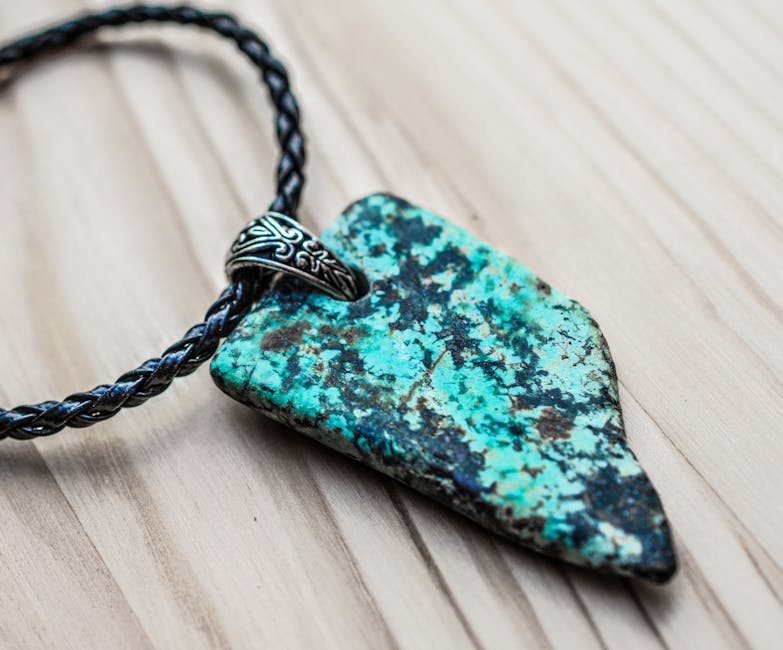
Turquoise is a phosphate mineral — copper aluminum phosphate, to be precise — that forms in arid regions where copper-rich groundwater percolates through aluminum-bearing rock over thousands of years. The copper gives it blue; iron in the mix pushes the color toward green. The dark veining you see running through most pieces isn't decoration — it's the host rock the turquoise formed within, called matrix, usually iron pyrite or limonite.
It's one of the oldest gemstones in continuous use. According to the GIA, turquoise artifacts have been found in Egyptian sites dating to approximately 5500 BCE — among the earliest gemstones intentionally mined and shaped for adornment. The Sinai Peninsula supplied most ancient Egyptian turquoise; the same mines were worked intermittently for over 4,000 years.
What makes turquoise unusual geologically is that it almost never forms in large, flawless pieces. Deposits are typically thin veins and nodules within host rock. High-quality, solid, matrix-free turquoise is genuinely rare — which is why so much of what reaches the market has been processed in some form.
The color range runs from pale sky blue through robin's-egg blue to sage and apple green. Neither end of the spectrum is inferior; the preference for blue over green is cultural, not geological. Persian turquoise, mined in northeastern Iran's Nishapur region for over 2,000 years, became the reference standard for intense blue largely because it was the first high-quality turquoise to reach European markets via the Silk Road. The name "turquoise" itself comes from the French for "Turkish," because the stone arrived through Turkish trading routes — a reminder that naming in gemstones often reflects commerce more than origin.
Photo: monicore / Pexels License
Grading Turquoise: What Actually Separates One Stone from Another
Turquoise doesn't have a formal grading system like diamonds, but there are four factors experienced buyers consistently use.
Color
Saturated, even color commands the highest prices. In blue turquoise, the benchmark is often called "Persian blue" — a deep, pure blue with no green cast, no pale spots, and stable color over time. Sleeping Beauty turquoise, from the now-closed Sleeping Beauty mine in Globe, Arizona, became famous for this quality: a clean, matrix-free blue that rivals Persian material. Since the mine closed in 2012, Sleeping Beauty prices have risen sharply on the secondary market. If a piece is sold as Sleeping Beauty, ask for provenance.
American Southwest turquoise — from Nevada, New Mexico, and Colorado — tends toward greener tones with heavier matrix. That's not a defect. Royston turquoise from Nevada, with its forest-green and teal tones against rich brown matrix, is highly sought by collectors. Your color preference should drive the choice, not a received idea that blue is categorically superior.
Hardness and Porosity
This is where the natural-versus-stabilized question gets practically important. Turquoise has a Mohs hardness of 5–6, which is softer than quartz. Porous, low-grade material can absorb oils from your skin, shifting color over time — sometimes interestingly, sometimes not. Hard, high-quality natural turquoise doesn't have this problem, but it's rare and priced accordingly.
Matrix
Matrix is neither good nor bad in itself — it's a matter of pattern. Spiderweb matrix, where thin dark veins form a fine lace-like pattern across the stone, is particularly prized by collectors. Heavy, irregular black patches are generally less desirable. Completely matrix-free stones are their own category, commanding a premium especially in Persian and Sleeping Beauty material.
Cut and Polish
Turquoise is almost always cut en cabochon — a smooth, domed oval or round without facets. The dome should be well-proportioned: neither too flat nor so high it looks bulbous. The back should be smooth or at minimum even. A rough-cut back that hides the stone's underside often signals the cutter was working around a problem in the material.
Photo: Ann H / Pexels License
Natural, Stabilized, Enhanced: What These Words Actually Mean
This is the section most guides skip or obscure. Here's what you're actually looking at on the market.
Natural Turquoise
Cut and polished with no treatment beyond physical shaping. Hard, high-quality natural turquoise that won't fade or crack in normal wear is genuinely rare and priced accordingly. If you're buying "natural turquoise" at a mass-market price, ask direct questions about treatment history.
Stabilized Turquoise
The most common treatment. Soft, porous turquoise is impregnated with a clear resin under pressure, which hardens the stone, deepens the color, and makes it durable enough for everyday wear. The GIA has documented turquoise stabilization as a standard industry practice — it's legitimate, widely used, and produces a perfectly wearable stone. The problem arises only when stabilized material is sold as natural without disclosure. Most turquoise jewelry at accessible price points is stabilized. That's not a scandal; it's just how the supply chain works. What matters is that you know.
Enhanced Turquoise
Treated with wax, oil, or dye to improve color. Wax and oil treatments are traditional and relatively benign; dye is more aggressive and can fade with time. Enhanced turquoise should be disclosed and priced accordingly.
Simulants and Assembled Stones
Howlite, a white mineral, dyes convincingly to turquoise blue and is sold as turquoise more often than you'd expect. It's softer (Mohs 3.5), often has a chalky rather than waxy luster, and lacks the density of real turquoise. Block turquoise — compressed turquoise powder bound with resin — is another category entirely, essentially a composite material. A warm needle pressed briefly to the surface of a plastic simulant releases a faint chemical smell; genuine turquoise won't.
One thing most buyers don't know: the color of natural turquoise can shift slightly toward green as it ages, because the iron compounds in the matrix oxidize over time. Stabilized turquoise doesn't do this. If you're handling an antique piece claimed to be Persian turquoise, a slight greenish cast compared to its original hue is often evidence of authenticity and age — not deterioration.
Turquoise in Protective and Symbolic Jewelry
Turquoise appears in protective jewelry across more traditions than almost any other stone. The connection is ancient enough to qualify as a near-universal human intuition. The Navajo and Pueblo peoples of the American Southwest used turquoise in ceremonial and protective contexts for over a millennium; the Smithsonian's National Museum of the American Indian holds some of the finest documented examples. In Persia, soldiers wore turquoise on armor and amulets. In Tibet, it was given between friends as a token of good fortune. The cross-cultural consistency isn't coincidence — turquoise is the rare stone that appears across nearly every hemisphere, and nearly everywhere it carries the same associations: protection, clarity, and vitality.
When you're choosing turquoise in a symbolic piece, setting matters as much as the stone. A bezel setting — where the metal wraps fully around the stone's edge — is the right choice for turquoise's relative softness. Open prong settings work for diamonds; for turquoise, you want the stone held securely with no exposed edge to chip.
The Sterling Silver Natural Turquoise & Diamond Eye of Horus Necklace pairs natural turquoise with the Eye of Horus, the ancient Egyptian symbol of healing and wholeness, in exactly this kind of protective setting — the turquoise center amplifies both the visual weight and the symbolic intention of the piece. The Eye — Sterling Silver Necklace with Turquoise & Diamond takes the same protective symbol in a more contemporary direction, the stone's blue-green providing the color resonance the evil eye form has always carried.
What's the difference between Persian turquoise and Sleeping Beauty turquoise?
Both are considered high-grade, matrix-free natural turquoise, and both set the benchmark for pure blue color. Persian turquoise from the Nishapur region of Iran is the historical standard — a deep, vivid blue mined for over 2,000 years. Sleeping Beauty, from Globe, Arizona, produces a lighter robin's-egg blue equally free of matrix. The Sleeping Beauty mine closed in 2012, making its stones increasingly scarce and expensive. Persian turquoise is still actively produced.
Is stabilized turquoise worth buying?
Yes, with two conditions: you pay a stabilized-material price, not a natural-material price, and the seller discloses the treatment upfront. Stabilized turquoise is durable, colorfast, and perfectly suited to everyday wear. Most accessible turquoise jewelry is stabilized — the issue isn't the treatment itself but undisclosed treatment sold as natural stone.
How do I tell real turquoise from howlite or plastic?
Visual cues: genuine turquoise has subtle color variation and a waxy luster; dyed howlite often looks unnaturally uniform in color. Weight: turquoise is denser than most plastics and composite materials. Temperature: stone feels cool to the touch; plastic warms quickly. A gemologist can confirm with a refractometer — turquoise's refractive index (1.61–1.65) is distinct from howlite (1.58–1.59) and glass.
Does turquoise change color over time?
Natural, untreated turquoise can shift color with exposure to body oils, cosmetics, and direct sunlight. This is why Persian dealers historically stored stones with great care. Stabilized turquoise is color-stable and doesn't shift. If you're wearing natural turquoise, remove it before applying lotion or perfume, and store it out of direct light.
What does turquoise symbolize in jewelry?
Across traditions: protection, good fortune, and clarity. Native American traditions associate turquoise with sky and water, using it in healing and ceremonial contexts. Persian tradition used it as protective ornamentation. Modern spiritual jewelry draws on all of these associations. Wear it for whatever resonates most — the symbolism is broad enough to be genuinely personal.
What is turquoise matrix, and is it a defect?
Matrix is the host rock visible within the turquoise — the dark veining or patches of brown, black, or gold running through the stone. It's natural, not a flaw. Spiderweb matrix (fine, lace-like veining) is specifically sought by collectors and commands its own premium. Whether matrix adds or subtracts value depends on its pattern and the piece's overall aesthetic.
Why does quality natural turquoise cost so much more than other blue stones?
Because hard, untreated, vividly colored turquoise in a consistent hue is genuinely rare. Unlike blue topaz, which is abundant and routinely heat-treated to enhance color, top-grade natural turquoise makes up a small fraction of what's mined. The rest requires stabilization to be durable enough for wear — which is fine, but means truly natural material commands a significant premium that reflects actual scarcity.
Turquoise rewards the buyer who takes a few minutes to understand what they're looking at. It's one of the few stones where the same visual can represent radically different material — and where knowing the difference lets you choose with confidence and wear with intention.