The Science of Diamonds: Formation, Light, and the 4Cs Explained
Share
In 1797, English chemist Smithson Tennant burned a diamond — deliberately, inside a sealed glass tube filled with oxygen. He held it over a flame until the stone was gone, then analyzed the gas that remained: pure carbon dioxide. The experiment, published in the Philosophical Transactions of the Royal Society, proved that the world’s most coveted material is chemically identical to graphite, charcoal, and the lead in a pencil. What makes diamond extraordinary is not its chemistry but its architecture: carbon atoms locked into a three-dimensional tetrahedral lattice, forged at temperatures around 1,300°C and pressures found only more than 100 miles beneath the Earth’s surface.
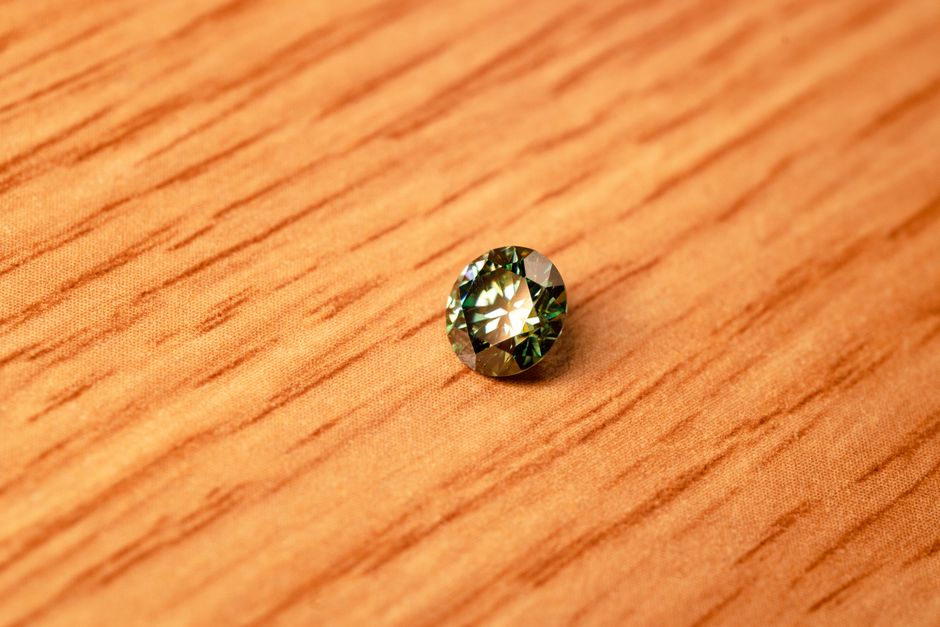
This structural reality explains everything about diamonds — their extraordinary hardness (Mohs 10), their optical behavior, and the way a well-cut stone turns white light into a private light show visible from across a room. As the Gemological Institute of America notes, no other gem combines diamond’s hardness, refractive index, and dispersion. Understanding the science behind these properties turns a diamond purchase from an act of faith into something you can evaluate with genuine confidence.
Photo: Jimmy Chan / Pexels License
Forged in the Deep Earth: How Diamonds Form
The conditions necessary to crystallize diamond do not exist anywhere near Earth’s surface. They occur in the lithospheric mantle, between approximately 90 and 200 miles underground, where temperatures range from 900°C to 1,300°C and pressures exceed 45 kilobars — roughly 1.3 million times atmospheric pressure at sea level. At these extremes, carbon atoms are forced into the cubic crystal lattice that defines diamond. Most diamonds found in fine jewelry today began forming between one and three billion years ago, in the Precambrian era, long before complex life existed on Earth.
A diamond sitting on a jeweler’s velvet pad has been traveling toward the surface for longer than the dinosaurs have been extinct — by a factor of at least twenty. According to the U.S. Geological Survey, the carbon that became these diamonds was likely incorporated into the mantle during Earth’s formation or through the subduction of carbon-rich seafloor material over billions of years.
Kimberlite Pipes: Diamond’s Delivery System
Diamonds would remain entombed in the mantle forever if not for a geological phenomenon with no modern equivalent: kimberlite eruptions. Named for Kimberley, South Africa — where the first major commercial deposits were discovered in the 1870s — kimberlite pipes are the eroded remnants of ancient deep-mantle eruptions. These events originated far deeper than ordinary volcanic activity, launching material upward at estimated speeds of 20 to 30 kilometers per hour in a process so rapid that the ascending diamonds cooled without converting to graphite, the stable form of carbon at surface pressures.
The resulting pipes are carrot-shaped columns of igneous rock that taper from a wide surface opening down to their deep mantle source. The Natural History Museum notes that kimberlite is the primary commercial source of diamonds worldwide, though diamonds are also recovered from alluvial deposits where ancient pipes eroded and distributed stones across riverbeds and coastlines over millions of years.
What Diamonds Carry from the Deep
Some of the oldest diamonds ever dated contain mineral inclusions that formed approximately 3.5 billion years ago — making them older than most of Earth’s continental crust. These inclusions are not flaws in any meaningful sense; they are time capsules. In 2014, a team led by University of Alberta geologist Graham Pearson published a landmark study in Nature describing a diamond from Brazil’s Juína region that contained a microscopic crystal of ringwoodite — a mineral only stable in Earth’s lower mantle, between 410 and 660 kilometers deep. The crystal contained water, providing the first direct evidence of a vast water reservoir stored in the deep mantle, potentially equal in volume to all of Earth’s surface oceans combined.
The finding made international headlines. A single, commercially unremarkable diamond had carried a message from 660 kilometers underground that geologists had been seeking for decades. Not every natural diamond harbors such discoveries, but every one of them is, in a literal sense, a geological archive of conditions that no longer exist anywhere humans can go.
Photo: Miguel Santos / Pexels License
Carbon’s Most Elegant Architecture
Diamond’s chemical formula is simply C. Crystal system: cubic (isometric). Mohs hardness: 10. These spare facts contain a great deal.
The cubic crystal structure means every carbon atom in a diamond is bonded to four neighbors at equal angles — a perfect tetrahedron, repeated in three dimensions across the entire crystal. This creates what material scientists call a covalent network solid: no separate molecules, no layers that can slide past one another, no structural weak points. The result is the hardest naturally occurring material on Earth by a substantial margin. Diamond rates 10 on the Mohs scale, not just slightly above the next hardest mineral (corundum, Mohs 9) but approximately four times harder in absolute terms.
This hardness has a direct practical consequence for jewelry. A diamond in daily wear accumulates essentially no scratches from ordinary life. The setting metal will eventually wear; the stone will not. The Natural History Museum’s mineralogy collections include diamonds recovered from ancient settings whose gemological properties are unchanged from the day they were cut — sometimes more than a thousand years ago.
One counterintuitive property: diamond is hard but not indestructible. Hardness measures resistance to scratching, not resistance to impact. Diamond is brittle — a sharp blow at the right angle can cleave a stone along its crystal planes. Gem cutters exploit this property deliberately when shaping rough stones. It is also why setting design matters: a bezel or protected prong arrangement shields the girdle from the kind of direct impact that can chip an otherwise perfect stone.
Photo: Tima Miroshnichenko / Pexels License
How Light Becomes Brilliance, Fire, and Scintillation
When gemologists describe a diamond’s visual performance, they use three distinct terms: brilliance, fire, and scintillation. These are not synonyms or marketing variations. Each describes a different physical phenomenon occurring in the stone.
Brilliance is the total amount of white light returned to the eye through the table and crown facets. A well-cut diamond acts as a light trap: entering rays reflect off the pavilion facets and exit back through the top rather than leaking through the bottom. This requires precise geometry — pavilion angles too shallow or too steep allow light to escape downward and the stone appears dim.
Fire is the dispersion of white light into spectral colors — the rainbow flashes visible when a diamond moves in light. Diamond’s dispersion value of 0.044 is significantly higher than most gems (sapphire: 0.018; spinel: 0.020; zircon: 0.039). This means a diamond separates wavelengths of light more dramatically, producing more visible color play under normal lighting conditions.
Scintillation is the shifting pattern of light and shadow as the diamond or the viewer moves — the “sparkle” of colloquial usage. It depends on the number and placement of facets and is what makes a diamond appear alive in ambient light, not only in direct illumination.
The Physics: Refractive Index and Critical Angle
Diamond’s refractive index of 2.417 is exceptionally high for a gem (glass: approximately 1.5; sapphire: 1.77; tourmaline: approximately 1.63). A high refractive index means light slows dramatically and bends sharply when it crosses from air into diamond. It also means the critical angle — the angle at which internal reflection becomes total, returning 100% of light rather than allowing any transmission through the back — is just 24.4 degrees. This small critical angle is why diamond retains light so efficiently: rays entering from a wide range of angles still bounce back up through the table.
No other gem used commonly in fine jewelry combines this refractive index with diamond’s dispersion value. The optical performance is a direct expression of the crystalline structure — physics, not mythology, though the mythology is understandable given what the physics produces.
Why Cut Is the Most Consequential Variable
A rough diamond contains all these optical properties in potential. Whether they are realized depends almost entirely on cut. The GIA’s diamond quality framework places cut first among the 4Cs for good reason: a flawless, colorless, 2-carat diamond cut to poor proportions will perform worse in light than a slightly included, near-colorless 0.7-carat stone cut to Excellent proportions.
The round brilliant cut — 58 facets in a standardized arrangement refined through the early 20th century, most influentially through Marcel Tolkowsky’s 1919 publication Diamond Design — is the result of mathematical optimization for all three light behaviors simultaneously. Fancy cuts (princess, oval, cushion, emerald) trade some brilliance or fire for different visual profiles; none outperforms a well-executed round brilliant on raw light performance, though aesthetic preference is entirely subjective.
The 4Cs: What They Actually Mean
The 4Cs grading system — Cut, Color, Clarity, and Carat weight — was standardized by the GIA in the 1940s and 1950s under the leadership of Robert M. Shipley, who founded the institute in 1931. Before standardization, diamond quality was described using regional and dealer-specific terminology: “river” for colorless, “top cape” for slightly yellow, “first water” for exceptional transparency. These terms varied by market and were impossible to compare across regions. The 4Cs created, for the first time, a universal language for diamond quality that could be verified on a grading certificate. The American Gem Society, founded the same year as the GIA, developed its own grading methodology and remains one of the two most respected independent diamond labs in the world today.
Cut: The One That Controls the Light
GIA’s cut grade for round brilliant diamonds runs from Excellent to Poor and incorporates brightness, fire, scintillation, weight ratio, durability, polish, and symmetry into a single composite assessment. For fancy shapes — ovals, cushions, pears, emerald cuts — GIA does not issue an overall cut grade, only polish and symmetry grades. This makes round brilliants the easiest choice for buyers who prioritize light performance and want a certification system that accounts for it holistically.
The practical guidance: for round brilliants, buy nothing below Very Good cut; Excellent cut is worth prioritizing over minor upgrades in color or clarity. The light performance difference between Excellent and Very Good is often negligible; the difference between Very Good and Good is sometimes visible in side-by-side comparison; the difference between Good and Poor is unmistakable to almost any observer.
Color: The D-to-Z Scale
GIA’s color scale runs from D (completely colorless) to Z (light yellow or brown). The distinctions between adjacent grades are invisible to untrained eyes in most lighting conditions. The difference between D and F requires laboratory conditions and a master comparison set to detect reliably. The threshold at which yellow tint becomes visible to most observers in a normal prong setting is approximately J or K.
In yellow gold settings, which warm the apparent tone of the stone anyway, I or J color is nearly indistinguishable from D or E to most viewers and costs significantly less. In white gold or platinum settings, H is generally the practical floor for a stone that reads as colorless in everyday wear. Paying for D-F in yellow gold is one of the more common ways buyers spend money on a difference that no one, including the buyer, will reliably see.
Clarity: Inclusions as Natural Signatures
Diamond clarity is graded on a scale from Flawless (FL) to Included (I3), with intermediate categories including Internally Flawless (IF), Very Very Slightly Included (VVS1 and VVS2), Very Slightly Included (VS1 and VS2), Slightly Included (SI1 and SI2), and Included (I1 through I3). Inclusions are internal characteristics — crystals of other minerals, feathers, clouds, or growth irregularities formed during crystallization billions of years ago. The GIA’s clarity grading system evaluates each inclusion by its size, nature, position, relief, and number.
The threshold that matters practically is “eye-clean”: the point at which inclusions are not visible to the unaided eye at normal viewing distance. This threshold is reached at SI1 or SI2 for most round brilliants. Paying for VS2 or higher buys security and resale value but rarely a visible difference in appearance. For emerald and asscher cuts, which have large open facets that display the stone’s interior clearly, VS1 or better is advisable — the step-cut facets function more like windows than mirrors.
Carat: Weight, Not Size
Carat is a unit of weight: 1 carat equals 0.2 grams. The name derives from the carob seed (Greek: keration), historically used as a counterweight on balance scales in gem markets across the ancient Mediterranean. The Victoria and Albert Museum’s jewelry history collections document the carob-seed standard in use across Roman, Byzantine, and medieval trade routes, making “carat” one of the older units of measure still in active commercial use.
Carat weight does not directly equal visual size. The same carat weight can appear larger or smaller depending on cut proportions and shape. A deeply cut 1-carat round brilliant may measure 6.3mm across the table; an ideally proportioned stone of the same weight measures closer to 6.5mm. Oval, pear, and marquise shapes appear larger than rounds of equal carat weight because their elongated form creates more face-up surface area per unit of mass.
Price per carat increases sharply at round-number thresholds — 0.50, 0.75, 1.00, 1.50, 2.00 carats — because consumer demand clusters around these benchmarks. A 0.95-carat stone of equal quality to a 1.00-carat equivalent typically costs 15 to 20 percent less with no visible size difference. This is one of the few diamond purchasing efficiencies that requires no trade-off whatsoever.
Natural Diamonds and the Meaning They Carry
The question of why natural diamonds belong in meaningful jewelry is not primarily sentimental, though sentiment is legitimate. It is also geological: a natural diamond is a physical object with a verifiable, specific history. Its age, formation conditions, and the billion-year journey to the surface are real properties of that particular stone — not metaphors, but actual facts about its matter.
“Adamas is the most valuable of gems, known only to kings.”
— Pliny the Elder, Naturalis Historia, 77 CE. The oldest surviving written description of diamond, noting its invincibility (adamas: “unconquerable” in Greek) centuries before its chemistry was understood.
Diamond’s use as a symbol of endurance appears in ancient Sanskrit texts, in Pliny’s Naturalis Historia, and in the courts of medieval Europe centuries before the engagement ring tradition was formalized. Archduke Maximilian I of Austria commissioned the first recorded diamond engagement ring in 1477 for Mary of Burgundy. The stone in that ring had been forming for at least a billion years before the moment it was given — a fact that was unknown at the time, but which does not make it any less true.
The Hope Diamond, housed at the Smithsonian’s National Museum of Natural History, weighs 45.52 carats and formed approximately 1.1 billion years ago. Its deep blue color comes from trace boron atoms substituted into the crystal lattice during growth — a quirk of its specific formation chemistry. Every natural diamond carries similar idiosyncrasies in its inclusions, trace elements, and growth patterns. No two are identical. This is not a selling point invented by marketers; it is mineralogy.
This is why natural diamonds in symbolic jewelry carry a different weight than decorative alternatives. A diamond star necklace in 14K gold pairs a celestial image with material that is, in a literal sense, as old as most of the constellations it represents. A diamond moon phase bar necklace pairs the oldest natural symbol of cycles with a stone that is itself the product of deep geological cycling over billions of years. A zodiac necklace with a natural diamond accent — particularly fitting in April, when Aries season brings the year’s first fire sign — grounds a celestial symbol in matter that is genuinely ancient. These connections are not manufactured; they are facts about the objects.
For diamond as the only element — the April birthstone in its plainest format — the Diamond Birthstone Necklace in 14K Gold sets a single natural diamond in a bezel on a delicate cable chain. No constellation, no celestial motif, just the stone. The matching Diamond Birthstone Stud Earrings in 14K Gold make the conventional pair for an April-born recipient — or for anyone whose collection runs to clean, symbol-free fine jewelry. Both are part of the broader Birthstone Edit, which covers all twelve months in the same format.
A diamond grading report from the GIA or the American Gem Society is the single most important document in a diamond purchase. These reports provide an independent, standardized assessment of the 4Cs alongside a plotting diagram of inclusions, fluorescence grade, and physical measurements. Without independent certification, quality claims are unverifiable.
Other laboratories grade diamonds, but their standards vary significantly. Stones graded by less rigorous labs are routinely assigned higher color and clarity grades than GIA would issue — a practice that inflates apparent value without changing the stone. The premium for a GIA-certified stone over a non-certified equivalent is almost always worth paying, particularly for center stones above half a carat.
The Trade-offs Worth Making
Prioritize cut above all other factors. An Excellent or Very Good GIA cut grade guarantees light performance. Color and clarity differences below certain thresholds are invisible to the naked eye; a poorly cut stone looks flat regardless of its other grades.
Color: H or I for white gold and platinum; J or K for yellow gold. The D-to-F range is analytically superior but the advantage is not visible in everyday wear, and the price difference is substantial.
Clarity: eye-clean SI1 or VS2 for round brilliants. Pay for Flawless or VVS only if there is a specific reason — resale strategy, certification value, or personal preference for the grade itself.
Carat: just below the round thresholds. A 0.90ct and a 1.00ct of equal quality look identical to most observers; the price difference does not reflect a visible difference in the stone.
Fluorescence: moderate to strong blue fluorescence often improves the appearance of H-J color diamonds in daylight by counteracting slight yellow tint — and these stones typically sell at a discount relative to non-fluorescent equivalents of identical quality.
For accent diamonds in meaningful jewelry — the kind set into a diamond-accented star necklace in 14K gold or a zodiac necklace with natural diamond accents — the stone is doing something different than a solitaire. Its job is not to be the primary visual statement but to add presence and life to the symbol it accompanies. Natural diamonds, even small ones, fulfill this role in a way simulants do not: the optical properties and geological reality are part of what makes the piece carry meaning beyond its appearance.
Diamond is pure carbon (chemical formula: C) arranged in a cubic crystal lattice. This is the same element found in graphite and coal, but the atomic arrangement under extreme pressure creates a material with completely different properties — the hardest substance in nature, transparent to most visible light, with a refractive index nearly three times that of ordinary glass.
How long does it take for a natural diamond to form?
Most natural diamonds formed between one and three billion years ago in the lithospheric mantle. The crystallization process takes place over geological timescales under sustained heat and pressure at depths of 90 to 200 miles. Lab-grown diamonds, by contrast, can be produced in weeks in a chamber that replicates the necessary conditions — but produce a stone with no geological history.
What is the difference between brilliance and fire in a diamond?
Brilliance is the return of white light to the eye through the crown and table facets — the overall brightness of the stone. Fire is the dispersion of that white light into spectral colors, producing rainbow flashes when the stone or viewer moves. Both depend on refractive index and dispersion; fire additionally depends on crown angles. A diamond optimized purely for brilliance at the expense of fire appears bright but slightly cold; most well-cut stones balance both.
Is cut really more important than the other 4Cs?
Yes, for almost all practical purposes. Cut determines what percentage of the stone’s optical potential is realized. The same diamond in Excellent versus Poor cut looks like two different stones in normal lighting. The difference between D and H color, or between VS1 and SI1 clarity, is often invisible to an untrained eye at normal viewing distance. The difference between Excellent and Poor cut is visible to everyone.
What does a GIA certificate actually tell you?
A GIA diamond grading report provides an independent assessment of the 4Cs (with specific grades for each), a diagram plotting the location of any inclusions, fluorescence intensity, measurements, and proportions. Every report has a unique number laser-inscribed on the diamond’s girdle, verifiable in GIA’s online report database. It is the only document that makes a diamond’s quality claims independently verifiable.
Why does diamond have such a high refractive index?
Diamond’s exceptionally dense, uniform covalent crystal lattice slows light far more than the looser structures of other gem materials. The high electron density in the tetrahedral carbon bonds interacts strongly with photons, reducing their propagation speed and causing sharp bending at each surface. This is a direct consequence of the same structural properties that make diamond so hard — the crystal architecture and the optical performance are inseparable.
What is the practical difference between natural and lab-grown diamonds?
Chemically and crystallographically, they are identical — both are cubic carbon with the same hardness, refractive index, and dispersion. A gemologist with the right equipment can distinguish them; a casual observer cannot. The difference is origin and history: natural diamonds formed over billions of years in the Earth’s mantle and carry geological characteristics specific to their formation environment. Lab-grown diamonds are produced in weeks. The optical properties are the same; the material history is not.
Intention, Made Tangible
A diamond is not remarkable because it is rare or expensive, though it may be both. It is remarkable because it is a specific material object with a verifiable geological history: one to three billion years of pressure, heat, and crystal growth made visible in a few millimeters of pure carbon. The way it handles light is not an accident of cutting artistry alone — it is the optical expression of a crystal structure that took the age of the Earth to build.
This is what makes natural diamonds in meaningful jewelry different in kind from decorative alternatives. When you wear a zodiac necklace set with natural diamonds, the material and the symbol reinforce each other: a celestial emblem in gold, set with stones that are as genuinely ancient as the stars the symbols represent. That is not marketing language. It is the actual, physical truth of the object — and it is what jewelry, at its best, has always been for.