

The Men's Jewelry Guide: What to Wear, Buy, and Why It Matters
The taboo against men wearing jewelry is approximately 200 years old. The tradition of men wearing jewelry is at least 7,000 years old. Somewhere in the Victorian era, Western culture quietly decided that jewelry was for women — and most men in the English-speaking world have been self-conscious about it ever since. That is not a long-standing truth. It is a recent and unusually provincial one.
Egyptian pharaohs wore gold collar necklaces, rings, and bracelets as markers of divine authority. Viking warriors wore arm rings as symbols of strength and oath-keeping. Roman emperors sealed laws with signet rings. None of them would recognize the idea that jewelry diminishes a man. What they would recognize is the impulse to wear something that means something. That has not changed.
This is a practical guide to what works, how to wear it, and what to look for when you buy.


Where the Stigma Came From — and Why It Doesn't Hold Up
The Metropolitan Museum of Art's scholarship on gold in ancient Egypt documents how pharaohs wore elaborate collars, pectorals, rings, and bracelets as expressions of royal authority and divine power. These were not decorative afterthoughts — they were political statements in metal, worn by the most powerful men in the world at the time.
The Norse took a different approach. The British Museum's collection of Viking arm rings documents how Norse warriors wore twisted silver and gold arm rings as portable wealth and oath-currency. A chieftain would break rings apart and distribute pieces to reward loyalty — the arm ring was adornment and social contract simultaneously. These were men who would find the idea of not wearing jewelry incomprehensible.
Roman men wore signet rings as tools of identity and authority. The Met's essays on Roman luxury arts note that Augustus himself wore a signet ring engraved with his sphinx, later switching to his own portrait — a ring worn by the most powerful man in the Western world and used daily to seal official documents.
Then came the late 18th and 19th centuries. As Gentleman's Gazette documents, the shift is traceable to what historians call the "Great Male Renunciation" — a broad cultural move away from ornamentation among Western men, driven by Enlightenment ideals of rationalism over display and the rising merchant class distinguishing itself from aristocratic excess. Jewelry, color, and elaborate dress became coded as feminine or frivolous. Functional pieces — watch chains, cufflinks, a single signet ring — became the acceptable limit.
That convention is roughly 200 years old in a tradition that runs at least 7,000 years in the other direction. Worth keeping in perspective when you are deciding whether to buy a necklace.
What Actually Works: Rings, Necklaces, and Scale
The practical questions matter more than the historical ones. What works on a man, how do you wear it, and where do you start?
Rings
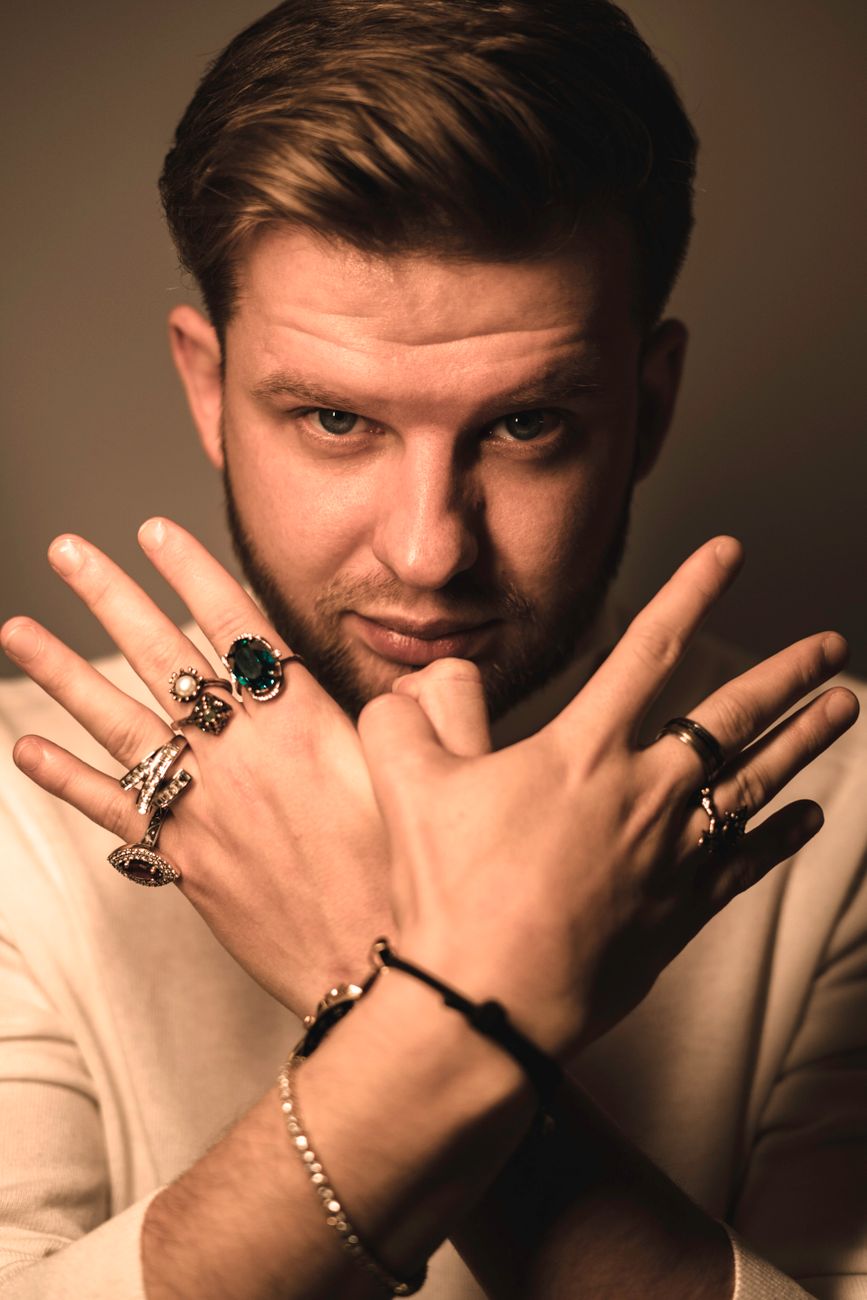
A single ring on one hand reads as intentional without being loud. The most versatile placement is the index or middle finger of the non-dominant hand — prominent enough to be visible, not competing with a watch or functional rings on the dominant side. A signet ring on the pinky carries European aristocratic associations that either suit your aesthetic or don't.
For men starting out: one ring, worn alone, is always the right entry point. Stacking — two or three rings on the same hand — can work, but requires attention to how pieces interact. A thick band alongside a thin one creates natural hierarchy. Two thick bands at the same knuckle reads as unintentional.
Scale matters more on men's hands than it might seem. The Celtic Knot Sterling Silver Men's Ring is built with this in mind — a substantial band with knotwork detail that holds visual weight without overwhelming the finger. The design carries meaning (continuity, endurance, the endless nature of important things) while reading as clearly considered in scale and execution. It is one of those pieces that works as a starting ring and stays relevant when you add others later.

If you want a symbolic ring without the band bulk, the Sterling Silver Hamsa Stackable Ring is a slimmer option — designed for stacking but works cleanly worn alone. The hamsa motif carries protective symbolism across Mediterranean and Middle Eastern traditions and reads as considered rather than decorative.

Necklaces
Chain length matters more for men because necklines are less variable. Most men's shirts fall in a predictable range, so the pendant sits in a consistent spot. An 18-inch chain sits at the collarbone; a 20-inch chain drops to the upper chest with an open collar; a 22-inch chain hits mid-chest and is the most common length for pendants worn under clothing.
A pendant worn under clothing is a private piece — you know it is there, others don't unless you choose to show them. A pendant worn over clothing is a public statement. Both are valid, but they serve different functions. Know which one you're buying before settling on chain length.
The Sterling Silver Eye of Horus Necklace is a strong entry point for men drawn to symbolic jewelry. The Eye of Horus has been associated with protection and clarity since ancient Egypt — it was a warrior's symbol before anything else. It reads as intentional and has enough visual specificity to communicate something without being overtly decorative.

For something with more architectural edge, the Sterling Silver Natural Diamond Eye of Providence Necklace carries similar weight — the all-seeing eye is one of the most structurally striking symbols in jewelry, and it works for men who want cultural depth that isn't immediately legible to most people. The diamond accent adds precision without softening the piece.

If meaning matters more than symbol recognition, the Om Sterling Silver Necklace is the quieter option — a small, well-made piece that carries philosophical weight without demanding attention. It sits easily under a shirt or over one, and the scale is right for most builds.


Symbols That Work Well for Men
Some symbols translate particularly naturally into men's jewelry — not because of gender convention, but because of their history, visual weight, and the kinds of meaning they carry.
The Eye of Horus
Originally a protective symbol associated with the warrior-king Horus in Egyptian tradition, the Eye of Horus has a visual directness that works at scale. It is structured and specific — not delicate or decorative — with thousands of years of protective intent behind it. The Sterling Silver Eye of Horus Necklace renders this without embellishment. A detail most people don't know: the mathematical proportions encoded in the parts of the Eye were used in ancient Egyptian medicine as fractions representing a whole — one of history's earliest examples of a symbol doing double duty as both image and numerical system.
Celtic Knot
The endless knot — a looping, unbroken line — has appeared in Celtic art since at least the 4th century CE. Its visual logic is continuity and interconnection: the idea that the important things do not have clean beginnings or endings. For men with Irish, Scottish, or Northern European heritage, the Celtic knot carries a specific identity marker. For anyone else, it carries a design discipline that reads as considered. The Knot Sterling Silver Necklace is the pendant version — architectural in its detail, understated in its finish.

The Hamsa
An open hand with an eye at its center, the hamsa predates the major religions that have since adopted it — Phoenician, Jewish, Islamic, and Christian traditions all use it as a protective symbol. For men, a hamsa ring or pendant works as a talisman without reading as religious. The Hamsa Sterling Silver Necklace with Diamond balances the symbol's visual boldness with the precision of diamond detail.

Balance and Om
For men drawn to Eastern philosophy or minimalist design, the Balance Sterling Silver Necklace is the most abstract option in this range — clean in form, clear in intent. Paired with the Om Necklace, the two form a quiet layered set built around complementary ideas. Neither piece announces itself; both wear well over time.

How to Buy: What Quality Actually Looks Like
Men's jewelry fails in one of two ways: it is too lightweight to read as intentional, or it is plated and starts showing wear within months. Both problems come from the same source — buying on price rather than construction.
Solid vs. plated
Gold-plated jewelry has a thin layer of gold over a base metal (usually brass or copper). That layer wears off — around edges, at contact points, wherever the piece flexes. For a dress necklace worn occasionally, plating is acceptable. For a ring or necklace worn daily, plating is the wrong choice. Look for sterling silver or solid gold. Sterling silver is 92.5% pure silver — durable, develops character over time, and polishes back to bright when you want it. All the pieces linked in this guide are sterling silver.
Weight and proportion
A piece that feels insubstantial in your hand will look insubstantial on the body. Weight is a proxy for quality — a well-made sterling silver ring should have noticeable heft relative to its size. If a piece feels hollow or light, it probably is hollow, which also means it is more susceptible to denting and damage under daily wear.
Chain construction
For necklaces, the clasp is the first failure point. A lobster claw or spring ring closure should feel solid — it should not spring open under light pressure. Chain links should be uniform and should not stretch or deform when pulled firmly. A good sterling silver chain should feel like metal in the hand.
The full Protective Talismans collection covers the range of symbolic men's pieces — eye, hamsa, horus — in sterling silver. For Celtic and knotwork pieces, the Continuity collection is the right place to start.
Frequently Asked Questions
Is it acceptable for men to wear jewelry?
Yes — and historically, it always has been. The Western taboo against men wearing jewelry is a recent cultural convention, roughly 200 years old, and it is actively unwinding. Men wearing rings, necklaces, and bracelets is increasingly common across style contexts. The more relevant question is whether a specific piece works for your build, your style, and your intention.
What jewelry should a man start with?
One ring or one necklace, worn alone, is the right entry point. A single intentional piece reads as deliberate; multiple pieces before you know what works for you can read as uncertain. If you are drawn to necklaces, start with one pendant on an 18–20 inch chain. If rings, start with one on the index or middle finger of your non-dominant hand. Wear it for a few weeks and see how it sits before adding anything else.
What necklace length works best for men?
An 18-inch chain sits at the collarbone and shows above most open-collar shirts. A 20-inch chain drops to the upper chest — the most common length for men's pendant necklaces. A 22-inch chain sits at mid-chest and works for pendants worn under shirts. Most men find 20 inches to be the most versatile: visible with an open collar, easy to tuck in when needed.
What finger should a man wear a ring on?
There are no binding rules. The index finger reads as assertive. The middle finger is the most neutral placement. The ring finger carries relationship connotations in most Western cultures. The pinky has a historical signet-ring association. Most men find the index or middle finger of the non-dominant hand to be the most natural starting placement — prominent without interfering with daily tasks.
Should men mix silver and gold jewelry?
Yes, but deliberately. Choose one dominant metal and let any accent in the other be secondary. A sterling silver necklace alongside a gold watch works well. Two silver rings and one gold ring on the same hand looks unresolved. For simplicity, sterling silver is the easiest base to build from — versatile, durable, and forgiving alongside most watch metals.
What is the best metal for men's jewelry?
For daily wear, sterling silver is the most practical choice. It is harder than fine silver, holds detail well, develops a warm patina over time, and can be polished back to bright when needed. It is also the most historically consistent choice — Viking arm rings, Celtic silverwork, and Roman pieces were all produced in silver. Solid 14K gold is the right choice for long-term investment pieces or if the warmth of yellow gold suits your aesthetic.
What symbolic jewelry works best for men?
Symbols with strong visual structure and historical roots in protection or identity tend to translate best — the Eye of Horus, the hamsa, Celtic knot patterns, the Om, and the signet ring form all have long associations with men's adornment across cultures. Delicate or abstract motifs without visual weight can feel undersized on larger hands. The key is choosing a symbol that has clear visual logic and personal meaning — a piece worn with conviction always reads better than one worn for trend.
The only barrier to men wearing jewelry has ever been social convention — and social conventions change. The more durable truth is that humans have always adorned themselves, that adornment communicates something real about identity and intention, and that the decision to wear something that means something is one of the oldest impulses in recorded history. It does not need more justification than that.
Browse the Protective Talismans and Continuity collections for men's pieces in sterling silver.


