

The All-Seeing Eye of Providence: Meaning and How to Wear It
One of the most recognized symbols in the world has been almost entirely co-opted by conspiracy theory. People see the eye in the triangle and their minds go immediately to secret societies and shadow governments. What they’re actually looking at is something far more interesting: a five-thousand-year-old visual argument that attention matters — that being fully present and aware of what you’re doing has meaning. That’s a surprisingly useful thing to carry on a chain.
The Eye of Providence — also called the All-Seeing Eye of Providence — is one of the most searched symbols in jewelry. Almost everyone recognizes it; almost no one knows its actual origin. That curiosity is the signal: this is a symbol people want to understand before they commit to wearing it. This guide gives you the full picture.

What the Eye of Providence Actually Is
The Eye of Providence is an eye set within a triangle, typically surrounded by radiating lines of light. The triangle points upward; the rays give the composition a sun-like quality. The visual logic is precise and deliberate: an eye at the center of an ordered, luminous structure suggests watchfulness that is both comprehensive and focused.
The symbol works on a fundamental human level because eye contact signals presence. A single eye drawn with intention communicates attention — directed at you, or for you. In jewelry, that ambiguity is useful. The Eye of Providence can mean: I am paying attention. I am fully present. Nothing that matters to me goes unnoticed. You decide what it means to you when you put it on.
The Sterling Silver Natural Diamond Eye of Providence Necklace translates the symbol’s geometry into fine jewelry precisely: a crisp sterling silver frame with a natural diamond at the eye’s center, so the piece literally catches and reflects light the way the original symbol always has. It reads as intentional rather than trendy — the kind of piece that holds up over years because its meaning doesn’t depend on what’s in fashion.

If you prefer the symbol to be a quieter presence, the Sterling Silver Stackable Eye of Providence Ring offers the same iconography in a slimmer profile — designed to stack with other bands without competing, carrying the symbol close to you more than announcing it to the world.

From Ancient Amulets to the Dollar Bill: The Eye’s Long Journey
The eye as a watchful and protective device appears across ancient cultures independently, which suggests the metaphor taps into something universally human. The Egyptians wore the Eye of Horus and Eye of Ra as amulets from at least 3,000 BCE — representations of attention and protection worked into faience, gold, and inlaid stone. The Sterling Silver Eye of Horus Necklace draws directly from that lineage: the characteristic detailed drawing of the Egyptian eye that predates the more geometric Providence version by millennia, visually richer and historically specific in a way the later symbol is not.

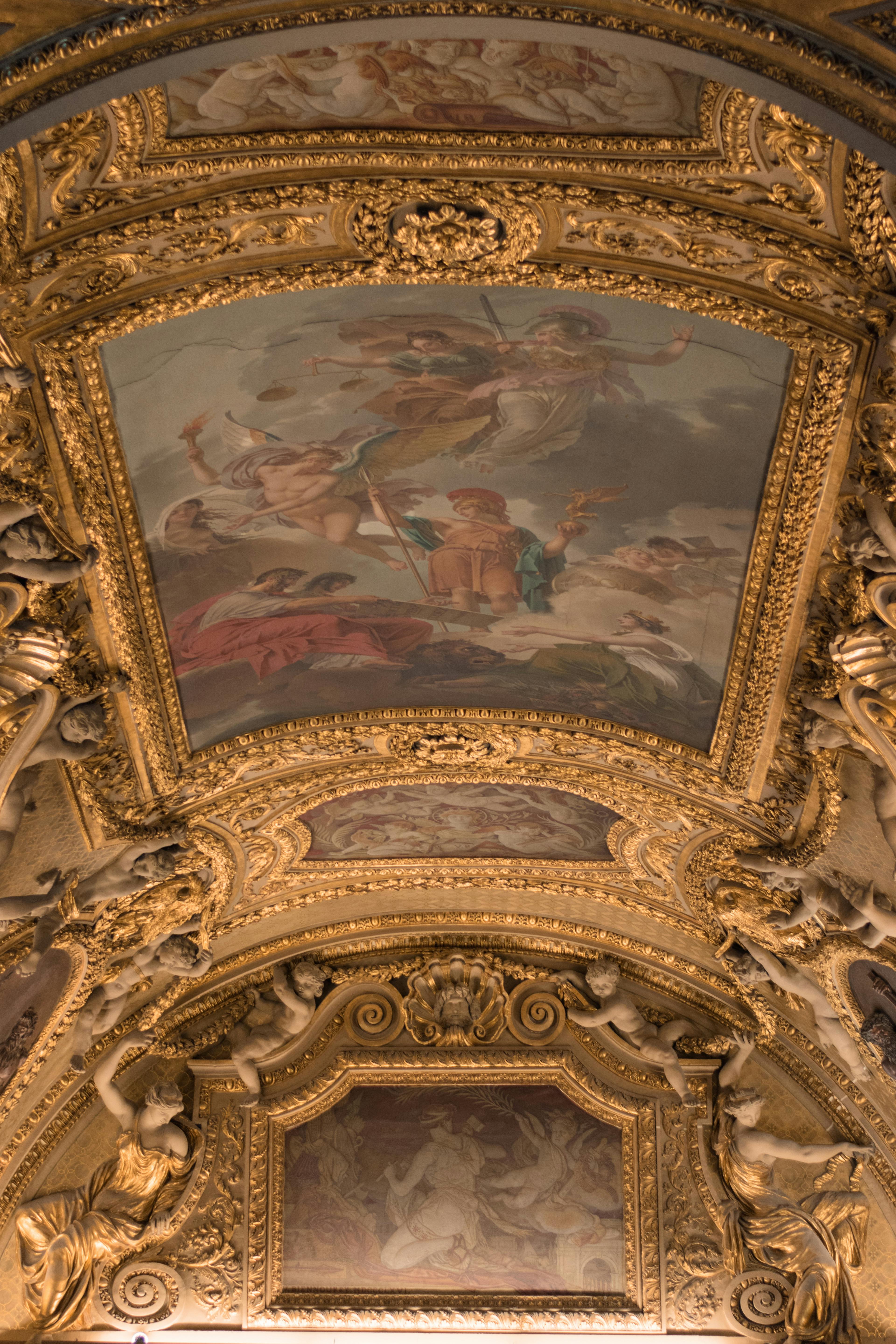
The specific composition we call the Eye of Providence — eye, triangle, radiance — emerged in Renaissance Europe as visual shorthand in art and printed texts: a way to communicate a significant concept with a single geometric form. By the 17th century it was appearing in painted ceilings, illustrated books, and architectural carving across Western Europe, always in the same essential configuration: a watchful eye framed by structured geometry and surrounded by light.
The version most people recognize today was designed in 1782 for the reverse of the Great Seal of the United States. As Smithsonian Magazine documents in its history of the Great Seal, the designer was Pierre-Eugène du Simitière, a Swiss-born heraldic artist brought in for his expertise in visual symbolism. He placed the Eye above an unfinished 13-step pyramid with the motto Annuit Coeptis — “Providence approves our undertakings” — a statement of national confidence, not a hidden message.
Here is the detail almost everyone gets backward: Freemasonry did not put the eye on the dollar bill. As the Great Seal historical record documents, Masonic lodges didn’t formally adopt the Eye of Providence as a symbol until the late 1790s — more than a decade after the Great Seal was finalized. The only Mason on any of the three design committees was Benjamin Franklin, and his design ideas were rejected entirely. The symbol ran from Renaissance art to national emblem before it ran to Freemasonry, and the Illuminati connection came still later, a 20th-century folklore attachment to a symbol that had spent five centuries meaning something far more straightforward: attention, awareness, and the weight of deliberate action.
What made the symbol endure across so many institutions is the same thing that makes it compelling in jewelry: it communicates significance at a glance. An eye framed in geometry and surrounded by light implies that something important is happening here, and that it is being noticed. The Metropolitan Museum of Art holds 18th-century Masonic pendant examples that show just how quickly organizations adopted the eye after it became a national symbol — within a generation, the Great Seal’s eye had become shared visual shorthand.

Eye of Providence vs. Evil Eye: Two Different Symbols
These two are visually adjacent — both center on an eye — but functionally opposite. Understanding the difference matters when you’re choosing what to wear and why.
The evil eye, or nazar, is a deflection amulet. Its purpose is to ward off harm caused by envy: the belief that others’ ill will, consciously directed or not, can affect you. Wearing an evil eye redirects that energy outward. It’s an interpersonal symbol, oriented toward your relationship with the people around you. For pieces that carry this warding, protective quality, The Eye — Sterling Silver Necklace with Turquoise & Diamond renders the nazar format with layered material depth: a turquoise ground and diamond accent give the classic evil eye real presence. The full range is in the Protective Talismans collection.

The Eye of Providence operates in a different register entirely. It’s not about other people. It’s about your own awareness and presence — the sense that what you do matters and registers. Where the evil eye is a shield, the Eye of Providence is a declaration. Most people who are drawn to it aren’t looking for protection from anyone. They’re looking for a symbol that reflects their own commitment to paying attention.
The Eye of Horus occupies a useful middle ground. It predates both the nazar and the Eye of Providence by thousands of years, and it carries qualities of both: watchful protection and personal presence. The Sterling Silver Natural Turquoise & Diamond Eye of Horus Necklace pairs the Egyptian eye design with natural turquoise and diamond for a piece that feels visually richer than the geometric Providence version — more illustration than symbol, better suited to someone drawn to the Egyptian lineage specifically. As the British Museum’s Freemasonry collection shows, eye symbols across traditions have always been collected, combined, and reinterpreted — which is why they feel simultaneously ancient and contemporary in modern jewelry.

How to Choose an Eye of Providence Piece
Scale and legibility
The Eye of Providence is a detailed symbol. At very small scales, the triangle, radiating lines, and iris compress into visual noise. Look for a pendant at least 12–15mm across so the composition has room to read. The Natural Diamond Eye of Providence Necklace gets this right: the diamond at center creates a focal point that anchors the design even at a refined size, adding the light-catching quality the symbol has always implied.
Pendant or ring
The pendant makes a statement: worn at the center of the chest, it positions the symbol where others will notice it. The ring version is quieter — more for you than for anyone watching. The Stackable Eye of Providence Ring has a slim, deliberate profile that sits cleanly alongside other bands. This is often the right choice when you want the meaning close without the announcement. Both versions work well; the question is how much of the symbol you want to declare versus carry.
Finish and detail quality
The radiating lines around the eye are what make the symbol feel alive. On well-cast pieces, they catch light and create a sense of movement; on lesser pieces, they flatten into indistinct marks. When evaluating a pendant in person, tip it at an angle to a light source — quality casting shows defined facets in the rays. A natural diamond center also matters: compared to synthetic or colored substitutes, it behaves differently in light and gives the piece lasting material value.
Chain length
A 16-inch chain positions the Eye of Providence pendant high on the sternum — front and center, visible above most necklines. An 18-inch chain drops it to mid-chest, which works better if you’re building a layered look. Because this symbol has strong geometric presence, it layers best as the statement piece rather than a secondary element behind something bolder.
Wearing It
The Eye of Providence is one of the more versatile symbols in fine jewelry because it has existed in so many cultural contexts simultaneously. Unlike symbols that signal membership in a specific tradition, this one has been absorbed into art, national iconography, architecture, and everyday visual culture over five centuries. Almost everyone recognizes it; almost no one has the same association with it. That broad legibility makes it a strong standalone piece. A fine silver chain, a clean neckline, a single Eye of Providence pendant at the sternum: that’s a complete composition.
It also layers well with other eye-adjacent pieces for a look built around a consistent visual theme. The Eye of Horus at a slightly shorter chain above, the Eye of Providence at a longer length below: two eye symbols in different visual registers — one detailed and Egyptian, one geometric and modern — both historically grounded, neither competing for the same visual space. Most people who wear the Eye of Providence stop explaining it after a while. The history behind the symbol tends to do the work.
Frequently Asked Questions
What does the Eye of Providence mean?
The Eye of Providence represents watchfulness, awareness, and the sense that actions have consequence — that what you do is noticed and matters. In modern wear, people choose it as a symbol of intention: a reminder to stay present, act deliberately, and take what they’re doing seriously. The specific meaning is yours to define.
Is the Eye of Providence connected to the Illuminati?
The Illuminati connection is a modern myth attached to a very old symbol. The Eye of Providence appeared in Renaissance art, was adopted for the US Great Seal in 1782, and wasn’t formally used by Freemasonry until the 1790s. The Bavarian Illuminati, founded in 1776, was disbanded by 1785 — before Freemasonry even adopted the symbol. The conspiracy theory emerged roughly 150 years after the Great Seal was designed.
What is the difference between the Eye of Providence and the evil eye?
The evil eye (nazar) deflects harmful envy directed at you by others — it’s an interpersonal protective ward, oriented outward. The Eye of Providence is about your own awareness and presence — it represents intentional attention, not protection from other people. Both symbols feature an eye, but they function in opposite symbolic directions.
Why is there an eye on the US dollar bill?
The Eye of Providence was placed on the reverse of the Great Seal in 1782, designed by Pierre-Eugène du Simitière. It appears above an unfinished pyramid with the Latin motto Annuit Coeptis (“Providence approves our undertakings”). The reverse of the Great Seal first appeared on the one-dollar note in 1935, which is when it became part of everyday American life rather than a ceremonial document.
What does the triangle around the eye mean?
The triangle gives the eye structure and geometric authority. Its upward point directs attention and creates visual ascent — the eye is elevated, focused, not floating. The three-sided enclosure frames the symbol completely, giving it weight and stability. In modern symbolic use, the upward-pointing triangle conveys direction, focus, and the sense that something significant is happening at the apex.
Is the Eye of Providence appropriate if I’m not religious?
Completely. The Eye of Providence has been in broad secular use — as a national symbol, an architectural motif, a design element in fashion and art — for over two centuries. Most people who wear it today are drawn to its visual strength and layered cultural history, not to any doctrinal meaning. The symbol has always traveled far beyond any single tradition.
Can I layer an Eye of Providence necklace with other pieces?
Yes, with attention to chain length. Because the symbol has strong geometric presence, it layers best as the focal piece in a multi-necklace stack rather than a secondary element behind something bolder. Pair it with a simple chain or delicate motif necklace at a shorter length above it, and let the Eye of Providence anchor the composition from below.
The All-Seeing Eye has been carved into stone, pressed into coins, painted onto ceilings, stamped on currency, and worn against skin for thousands of years across dozens of cultures. That staying power doesn’t come from conspiracy. It comes from the symbol doing something true: capturing the idea that full attention is a form of care — that being present and aware in whatever you’re doing is worth something. Wear it for that. It’s reason enough.


