
Sun Jewelry: Ancient Symbolism and How to Choose the Right Piece
No symbol appears in more cultures than the sun. The Egyptians built entire temple complexes to track it. The Aztecs carved 24-ton calendars to honor it. The Japanese made it the centerpiece of their imperial identity. The Norse, the Romans, the Inca, the Hindus — every one of them, working without contact with each other, decided the sun was the most important thing in the sky and made jewelry to reflect that. That kind of convergence does not happen with invented symbols. It happens when everyone agrees on what matters most.
What makes the sun ideal as something to wear is that it carries meaning without requiring interpretation. Energy, warmth, clarity, the reliable arrival of light after darkness — that is what it has always meant, in every language. It is one of the few symbols you can put on and know the message is being read correctly.


What the Sun Has Meant Across Six Civilizations
The Egyptians are the most well-documented example. Solar theology was not peripheral to Egyptian culture — it was the organizing principle. The Metropolitan Museum of Art's scholarship on the Old Kingdom describes the pyramid itself as a solar symbol — a shaft of stone representing the sun's rays, designed to connect the pharaoh's legacy to Ra. By the Fifth Dynasty (around 2450 BCE), kings were building dedicated sun temples alongside their pyramid complexes. The solar disc was not decoration; it was the central metaphor of a civilization that lasted 3,000 years.
The Aztecs built their own solar cosmology. Their great Calendar Stone — commissioned by Moctezuma, weighing 24 tons — places the face of Tonatiuh, the sun deity, at its center. Scholars at Mexicolore document that the four panels surrounding the central face represent the four previous ages of the world. The Aztecs believed their present age could end — that the sun required active sustaining. This made the sun not just a symbol of warmth but of obligation: something worth tending daily.
In Japan, the sun goddess Amaterasu is considered the ancestor of the imperial family, and the rising sun has remained the central emblem of the national flag. In Norse Bronze Age metalwork, solar wheels — circles divided into spokes — appear across Scandinavian jewelry with remarkable consistency. The Trundholm Sun Chariot, a 3,400-year-old bronze artifact found in Denmark, depicts the sun as a disc being carried across the sky: the same underlying image as Ra, developed independently on the opposite end of Europe.
The convergence is the point. When diverse civilizations with no contact arrive at the same symbol, it means the symbol is encoding a shared human experience — the warmth, the direction, the renewal after dark. That is what you are wearing when you put on a sun necklace.
The Three Forms of Sun Jewelry and What Each Projects
The way a sun is rendered changes how a piece reads and how it wears. A disc, a rayed sunburst, and a geometric sun carry noticeably different visual tones — and knowing the difference helps you choose the right form for how you actually dress.
The Plain Disc
The most elemental form: a circle, representing the sun at full intensity, unadorned. The Egyptian Aten was depicted exactly this way — a clean disc, no personification, just the shape of the solar body itself. In modern jewelry, the plain disc is the confident choice. It does not explain itself. The Sun Disc Necklace in 14K Solid Gold takes this approach — a solid 14K piece where the weight and warmth of the gold does the work. It layers cleanly because it does not compete for attention; it is quietly expressive rather than overtly symbolic.

The Sun with Rays
The rayed sun — a disc with alternating straight and wavy rays — is the version most people picture when they think "sun symbol." In traditional iconography, straight rays represent light and wavy rays represent heat. The Milgrain Sun Necklace in 14K Gold renders this form in milgrain detail — small beaded metalwork along the edges that catches light at different angles. It is more ornate than a plain disc and makes a stronger visual statement. Best worn as a standalone piece at a shorter chain length (16–18 inches) rather than layered with other pendants.

The Geometric Sun
Distilled to angles and planes, the geometric sun reads modern and architectural rather than classically symbolic. It gives you the meaning without the iconography — someone who recognizes the form will see it; everyone else will simply find it striking. The Geometric Sun Necklace in 14K Gold works this way: clean lines, deliberate symmetry, no decorative flourishes. If your wardrobe skews contemporary or minimal, this is the sun piece that fits without reading as overtly symbolic at a glance.

Most people don't know this: nearly all historic sun jewelry across cultures used gold specifically because of its color — the metallic yellow was understood as a direct correspondence to solar light, not just a mark of value. Yellow gold for a sun piece is not stylistic convention; it is the original choice, made independently for the same reason across completely unrelated civilizations.
How to Choose and Wear Sun Jewelry
The decisions that determine whether a sun piece works for you are simpler than they seem: scale, chain length, metal tone, and whether you are wearing it alone or as part of a layered set.
Scale and neckline
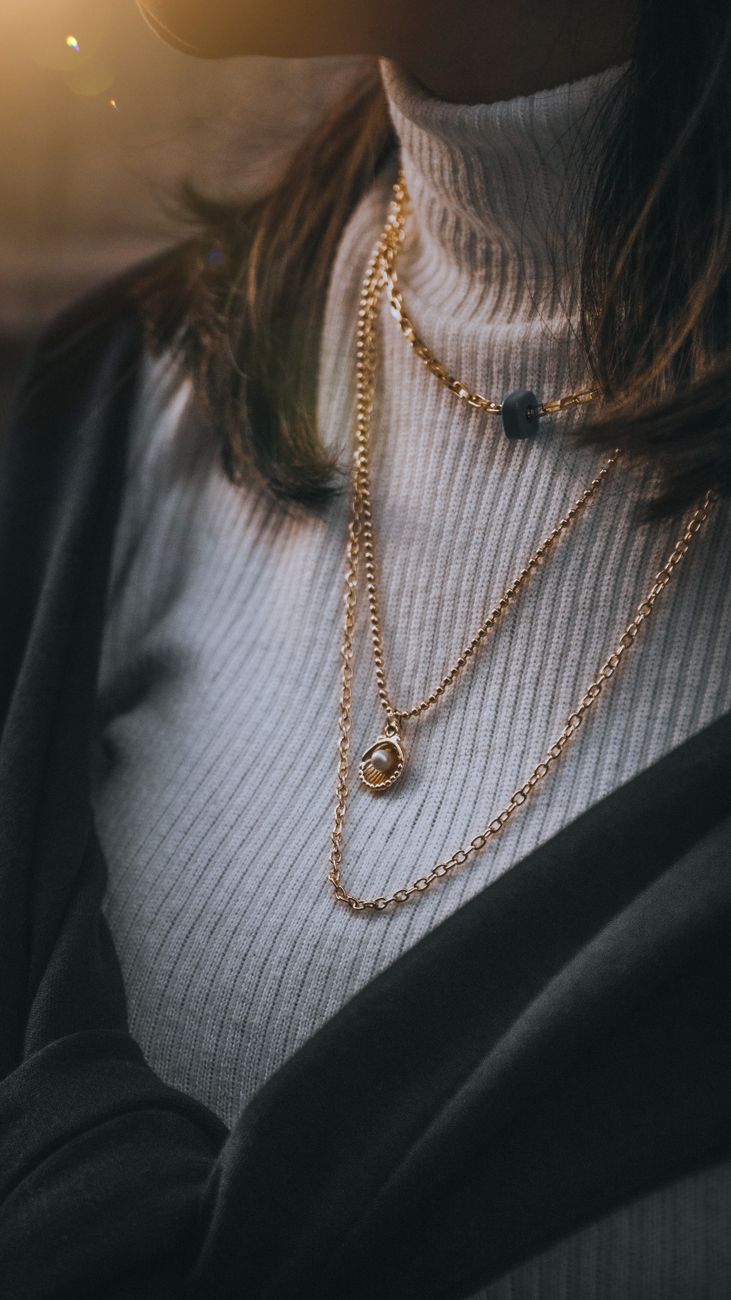
A sun pendant works best when it sits in open space at your neckline — visible and uncluttered. For crew necks and turtlenecks, wear the pendant at the collarbone or just below (16–18 inch chain). For V-necks and scoop necks, a longer chain (18–20 inches) lets the pendant follow the neckline's shape rather than sitting above it. Off-shoulder and strapless looks are where a disc pendant earns its place most clearly — nothing competing with it, nothing framing it except the line of your collarbone.
Layering with other celestial pieces
Sun jewelry layers naturally with moon and star pieces because they share a visual language without repeating each other. A sun disc on an 18-inch chain, the Crescent Moon and Star Necklace in 14K Solid Gold on a 16-inch, and the Diamond Star Necklace in 14K Solid Gold on a 20-inch creates a complete celestial set with natural proportion — each piece occupies different vertical territory on the chest so they do not compete. The Celestial Signatures collection is built around exactly this kind of visual coherence across pieces.


The rule for layering: vary both chain length and pendant scale, not just the symbol. Two similarly sized disc pendants on the same chain length will look cluttered even if the designs differ. A star pendant notably smaller than your sun disc creates visual hierarchy. A crescent moon that sits 2 inches higher creates rhythm. These proportional choices are what separate a layered look from a pile of chains.
Yellow gold, white gold, or rose gold?
For a sun motif, yellow gold is the obvious choice — the warmth of the color reinforces the symbol in a way white gold cannot. White gold works if your wardrobe skews cool-toned (grays, navy, black) and you want the sun form without the warmth. Rose gold is the middle ground: warm but softer in tone, suited to people who find yellow gold too bright. The Diamond Accented Star Necklace in 14K Gold pairs easily with any of the sun pieces in yellow gold and adds textural contrast through the diamond accents.

Alone or layered?
A plain sun disc worn alone at collarbone length reads as intentional and self-contained — one clean statement. If you are layering, it works best as the middle piece in a three-chain stack, flanked by simpler chains above and below. The one outcome to avoid: a sun pendant tangled with other pendants of similar scale at the same chain length. It muddles both pieces. Go alone, or go with pieces of noticeably different scale and chain length.
Why the Sun Feels Important: What Science Confirms
The sun's status as the most universal symbol is not only poetic. There is a physiological basis for why humans have always treated it as exceptional.
A study published in The Lancet found that the brain produces serotonin in direct proportion to the duration of bright sunlight exposure — with production dropping to its lowest point in winter months. The ancient response to the sun's return was not purely metaphorical. It was the body responding to something that genuinely changes how you feel. Sun worship, from a neurochemical standpoint, was a rational response to observable data.
A review from NIH's Environmental Health Perspectives further documents sunlight's role in vitamin D synthesis, circadian rhythm regulation, and immune function. The ancients were working empirically: they knew the sun made crops grow, made people feel well, made the world navigable. The science confirmed the observation several thousand years later.
As History.com documents, cultures from ancient Egypt to Northern Europe built their most significant calendar events around the summer solstice. Stonehenge is aligned to the solstice sunrise. The Karnak temple in Egypt catches solstice light through its central axis. These were not decorative choices — they were engineering decisions made by people who understood that the sun's behavior was worth tracking and marking with precision.
What this means for the symbol: it has genuinely earned its place. When you wear a sun, you are not adopting a trend. You are wearing something that has been universally understood as valuable for longer than any culture currently in existence. That is a different relationship with a symbol than picking one because it appeared in a season's editorial spread.
Frequently Asked Questions
What does sun jewelry symbolize?
The sun represents light, warmth, energy, and renewal. Across every culture that has used it as a symbol, the core meaning is consistent: life force, clarity, and the reliable return of good things after difficult periods. It is one of the few symbols with genuinely universal meaning — no cultural context required to read it correctly.
Is a sun necklace a good gift?
Yes — particularly for someone navigating a new chapter, a recovery, or any kind of emergence. The sun rising after darkness is a direct metaphor for getting through hard things. It is also non-denominational, which makes it a safer symbolic gift than many alternatives. A Milgrain Sun Necklace or Sun Disc in 14K solid gold is a piece that will outlast the occasion that inspired it.
What is the difference between a sun disc and a sunburst necklace?
A sun disc is a clean, flat circle — simple and elemental, based on the solar disc form used in Egyptian and other ancient jewelry traditions. A sunburst adds rays radiating from the center, making the symbol more explicitly solar and more ornate. The disc reads more minimalist and modern; the sunburst is more classically symbolic. Compare the Sun Disc and the Milgrain Sun Necklace to see how the two approaches differ in scale and tone.
Can you layer a sun necklace with other pieces?
Yes — celestial pieces layer well together because they share a visual language without repeating each other. The key is varying chain length and pendant scale so each piece has distinct vertical space. A sun disc, a crescent moon, and a small star can all occupy the same neckline without competing if they are spaced correctly — typically 2-inch increments between chain lengths.
What metal is best for sun jewelry?
Yellow gold is the traditional and most visually resonant choice — its color was the original reason solar deities were depicted in yellow across unrelated cultures. For daily wear and durability, 14K yellow gold is the right balance: hard enough to hold up, warm enough to read correctly. Sterling silver works well if you prefer cooler tones or are building a wardrobe of silver-toned pieces.
Is sun symbolism associated with any specific religion or culture?
No. Solar symbolism predates all major world religions and appears independently across every inhabited continent. It is one of the genuinely pre-religious symbols — you do not need to identify with any tradition to wear it. It means what it means: light, energy, and warmth.
How do I choose between the different sun necklace designs?
For a clean, minimalist piece that layers easily: the Sun Disc. For a more ornate, classically symbolic statement piece: the Milgrain Sun. For modern, architectural jewelry over classic symbolism: the Geometric Sun. All three are 14K solid gold — the choice is purely about which form reads right against your style.
The sun has been earning its place as a symbol for longer than any religion, political system, or cultural movement that has adopted it. Every civilization that has ever looked up and depended on it found a way to carry it close. That is not sentiment — it is a very long record of people deciding that this particular meaning was worth keeping near the body.
Explore the full Celestial Signatures collection for sun, moon, and star pieces in 14K solid gold.


